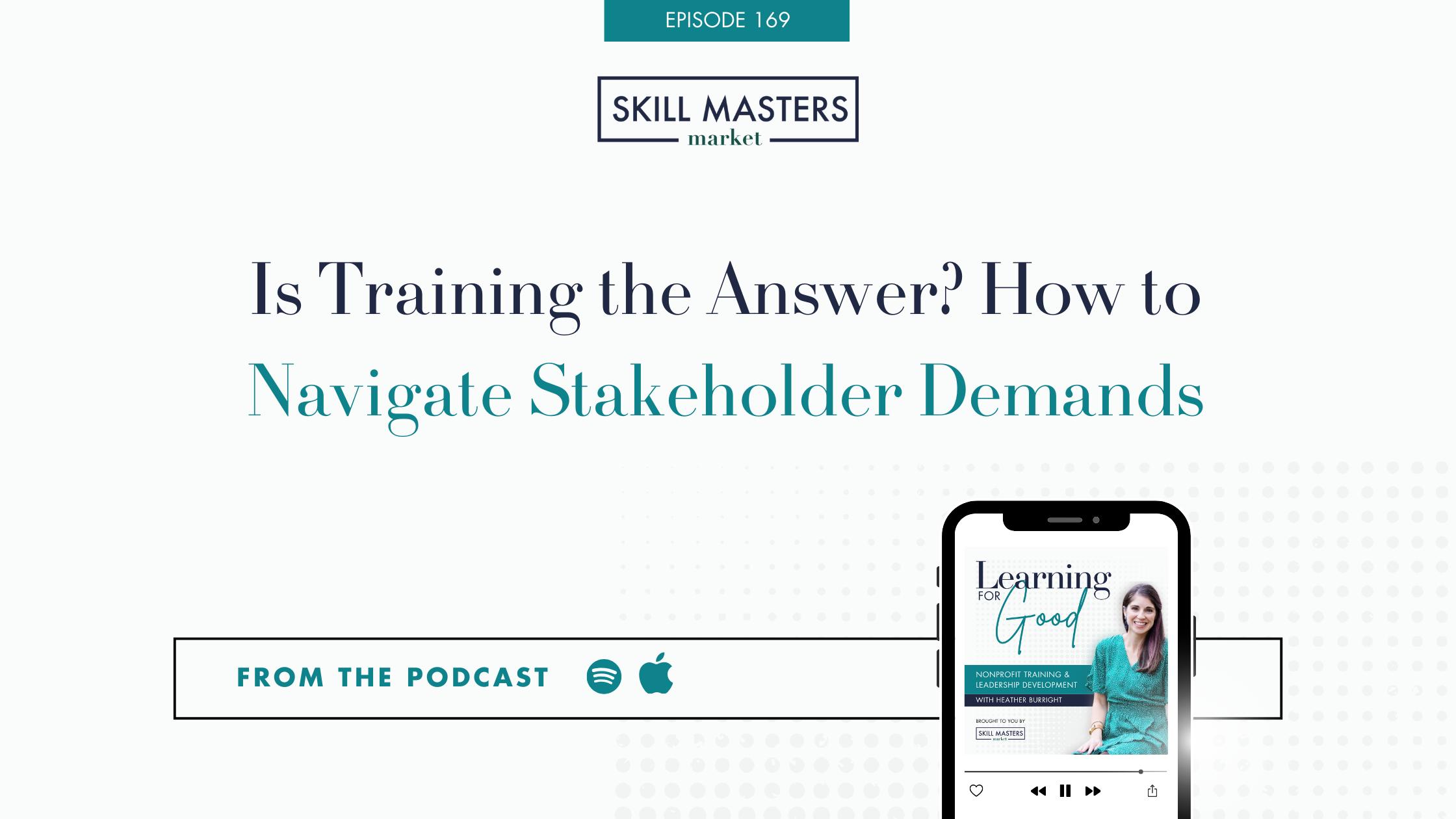
It can be frustrating when nonprofit leaders and other stakeholders approach us demanding training to solve a problem. However, it's important to remember that people outside of learning and development don't always know which tools are available or which one is right for each situation, so they stick to the familiar. But it's our job as nonprofit L&D pros to diagnose the problem and offer the right solution.
That's why in this episode, I'm sharing a quick diagnostic process to help you determine whether the issue brought to you is a training problem or if another solution will work better.
▶️ Key Points:
00:00 Why we often go for training as the solution
04:19 Two questions to diagnose a training problem
09:46 Navigating the diagnostic and stakeholders
Moving from Order-Taker to Strategic Learning Partner
In the fast-paced world of nonprofit growth, a common frustration for leaders is the feeling that while the organization is expanding, the staff aren’t quite keeping up. You might find yourself fixing the same performance issues repeatedly or wondering how to transform a team from mere executors into confident, capable leaders. When these gaps appear, the natural instinct for many stakeholders is to reach for the most familiar tool in the shed: training.
However, as I share on episode 169 of the Learning for Good podcast, a hammer will not tighten a screw. Even if you are determined to make it work, a hammer is simply the wrong tool for that specific task. If you want to tighten a screw, you need a screwdriver. But our stakeholders often want us to bypass the "screwdriver"—the job aid, the checklist, or the simple communication—in favor of the "hammer," which is formal training.
To build a high-performing organization, we must stop navigating by familiarity and start navigating by diagnosis. Our role as nonprofit L&D professionals is to identify the root of the problem and offer the solution that actually fixes it, allowing us to fuel the mission impact we are truly capable of. And that means influencing our stakeholders to try alternative solutions.
Two Questions to Diagnose Learning Needs
It is understandable why stakeholders—and even some L&D pros—default to training. It is often a combination of three factors: not knowing what other tools are available, not knowing when to apply them, or simply feeling uncomfortable with solutions that don't look like a traditional classroom experience.
When a stakeholder approaches you demanding a training program, it can feel as though your expertise is being overlooked. It can feel like you aren't being viewed as a strategic partner, but rather as an "order-taker." However, this demand often stems from a lack of awareness regarding the diverse tools in your L&D toolbox.
The shift from order-taker to strategic partner begins with curiosity. Instead of reacting to a demand, we must ask the right questions to diagnose the situation. By doing so, we move the conversation away from the solution (training) and back toward the problem (the performance gap).
Identify the Behavior Change: What Do People Need to Be Able to Do?
One of the most vital questions in any intake conversation is: What do people need to be able to do?
The focus of this question is strictly on action.
Why is this important? How does it impact learning design decisions?
If the stakeholder can define the need through a series of actions, you are likely looking at a situation that requires practice. When a staff member needs to perform a new behavior or master a complex skill, they need to experience it, try it, and potentially fail in a safe environment before doing it in the real world.
If we need practice, we generally need training.
Here’s an example:
Consider a common request: “We need to train our people managers on how to hold effective one-on-one conversations." When you dig deeper, the stakeholder might clarify that managers need to give better feedback to resolve performance issues early.
Giving feedback is a skill. It isn't just information that can be read in a manual; it is an action that involves nuances in tone, timing, and empathy. To master this, managers don't just need to know what feedback sounds like; they need to practice delivering it.
In this scenario, training is the correct tool.
A well-designed training program would allow managers to:
Practice the specific action of giving feedback.
Reflect on the emotional discomfort that often accompanies these conversations.
Receive feedback on their own delivery.
Because the core need is an action, training is actually the right tool for this specific need.
Identify the Knowledge Gap: What Do They Need to Know and How Will They Retrieve that Information?
Often, when you ask a stakeholder what people need to do, they will instead provide a long list of things people need to know. While you should keep digging for the action, it is important to acknowledge that people usually do need specific information to perform a task.
That’s why the secondary diagnostic question is: What do they need to know to perform that action, and how will they retrieve that information?
Why is this important? How does it impact learning design decisions?
This is where we distinguish between Recognition/Reference and Recall. This distinction helps you determine whether to build a training module, a job aid, or another solution.
Recognition and Reference (The Job Aid)
If a staff member needs to be able to look something up or refer to a set of steps while they are working, they do not need to memorize that information. In fact, forcing them to memorize it through training is often an inefficient use of time and resources. In these cases, the right tool is a job aid, a checklist, or a clear communication. These tools allow the information to live outside of the human brain, where it can be accessed exactly when it is needed.
Recall (The Training)
If the information must be recalled instantly—perhaps because the staff member is in a high-pressure situation where they cannot stop to look at a manual—then that information might be better suited for training. Training helps move information from external sources into long-term memory through repetition and application.
Here’s an example:
Returning to our people managers, they certainly need to know HR policies to give effective feedback. They need to know when an issue should be escalated or what the legal boundaries of a performance discussion are.
However, do they need to memorize every line of the HR policy? Likely not. They need to be familiar with it and know how to retrieve it so they can refer back to it over time.
In a strategic L&D plan, you might incorporate the use of the policy into a training session (e.g., "Open your manual to page 5 and find the escalation clause"), but you would not create a training session on the policy itself. This saves time and ensures the manager knows how to use the information while they are performing the action.
Navigating the Nuance: When to Use Blended Learning Solutions
While these two questions provide a powerful framework, it is important to acknowledge that not every situation is easy to diagnose. There is often nuance involved in human performance.
A complex skill like leadership or feedback won’t be solved by a single 60-minute workshop.
It might require a blended learning approach, which could include:
Training for the initial practice of skills.
Coaching for long-term behavior change.
Job Aids for reference during the workday.
Peer Support for reflection, encouragement, and accountability.
By identifying the different "tools" required for different parts of the problem, you build a more robust capacity for your organization.
Your Biggest Challenge: The Stakeholder Relationship
Perhaps the hardest part of being a nonprofit L&D pro isn't the design work; it's the relationship.
Even when you have a clear diagnosis, you may encounter stakeholders who continue to push for training because it is the only solution they understand.
You cannot get better at these conversations if you cannot explain why training can or cannot solve a specific problem. You must be able to articulate why a job aid is a more effective solution for a policy update than a three-hour webinar.
This requires that you continue to invest in your own professional development and growth so you have the language you need to align their needs and learning best practices. A great way to do this is to join the Nonprofit L&D Collective. It’s a community of nonprofit L&D pros who share what’s working and what isn’t, who share resources, and who commit to growing together over time.
Getting better at these conversations also requires tact and consistency. You cannot react with frustration when a stakeholder demands a training program that you know won't work. Instead, you must continuously use curiosity and diagnostic questions to build trust over time.
And remember, sometimes it’s better to be “in relationship” than it is to be right.
Your Biggest Asset: The Stakeholder Relationship
While the stakeholder relationship can be the biggest challenge, it can also be your biggest asset. It’s important to continue to build that relationship and nurture it over time. This is how you become a strategic partner.
How do you know when your efforts are working? It isn't when you launch a perfect course.
The "win" happens when a stakeholder approaches you and, instead of saying, "We need a training," they say, "We have a problem."
That shift in language is the ultimate sign of trust. It means they no longer see you as someone who just "makes slides," but as a diagnostic partner who can help them figure out which tool—be it a hammer, a screwdriver, or something else entirely—will actually fix the issue and move the mission forward.
Key Takeaway for Learning & Development
As you look at the challenges facing your nonprofit in the coming months, I encourage you to pause before you start building your next training deck. Ask yourself and your stakeholders those two critical questions:
What do people need to be able to do?
What do they need to know to do those things, and how will they retrieve that information?
By staying focused on the "doing,” you can navigate these conversations more strategically, offer the right solutions, and create real impact for your organization.
To learn more about diagnosing learning needs, tune into episode 169 of the Learning for Good podcast.
Additional Resources Just for You
Other Helpful Podcast Episodes:
Subscribe to the Nonprofit L&D Insiders.
Join the Nonprofit L&D Collective.
Support the Learning for Good Podcast
Become a sponsor.
Ask a question or suggest a topic.
We love hearing from listeners!
Leave a review.
Reviews teach us what content resonates most and help us reach more people!