Using People Managers to Build a Learning Culture
Nonprofit leadership development is about far more than offering training. It’s about creating an environment where people want to stay, grow, and contribute meaningfully to your mission.
In this episode, I’m joined by bestselling author and workplace growth champion Julie Winkle Giulioni, who challenges nonprofits to rethink how they approach staff development and build truly supportive cultures of learning. You’ll hear strategies for building a culture of learning in nonprofits and why effective leadership training programs for nonprofit staff require more than a single workshop.
We explore why training alone cannot drive behavior change, how managers can become true growth partners, and the role technology (especially AI) now plays in sustaining learning.
▶️ Key Points:
03:24 Julie’s winding career path and early lessons in learning
09:41 Why training isn’t enough to drive real change
15:03 A manager’s influence on performance and growth
24:34 How L&D leaders can operationalize better learning environments
28:37 Bringing learning into everyday work
Why Training Alone Is Not Enough
In the workplace, when a need, challenge, or performance issue arises, our first instinct is often to go to training as the solution. While training is important, it is only one piece of the puzzle.
On episode 168 of the Learning for Good podcast, bestselling author Julie Winkle Giulioni, a champion for growth in the workplace, explains why traditional training struggles to deliver lasting change:
Shrinking Resources and Attention
We are living in an era where "busy" is the most popular word in our vocabulary. Time dedicated to learning has become increasingly challenging, not just in nonprofits, but in for-profit organizations as well. Budgets for L&D have shrunk dramatically, and attention spans (or the perception of them) have followed suit. We've gone from week-long training sessions to demands for half-day sessions, or even a quick “injection” of leadership. This shrinking capacity means traditional training cannot be the exclusive answer for complex behavioral change.
The Forgetfulness Factor and Environmental Resistance
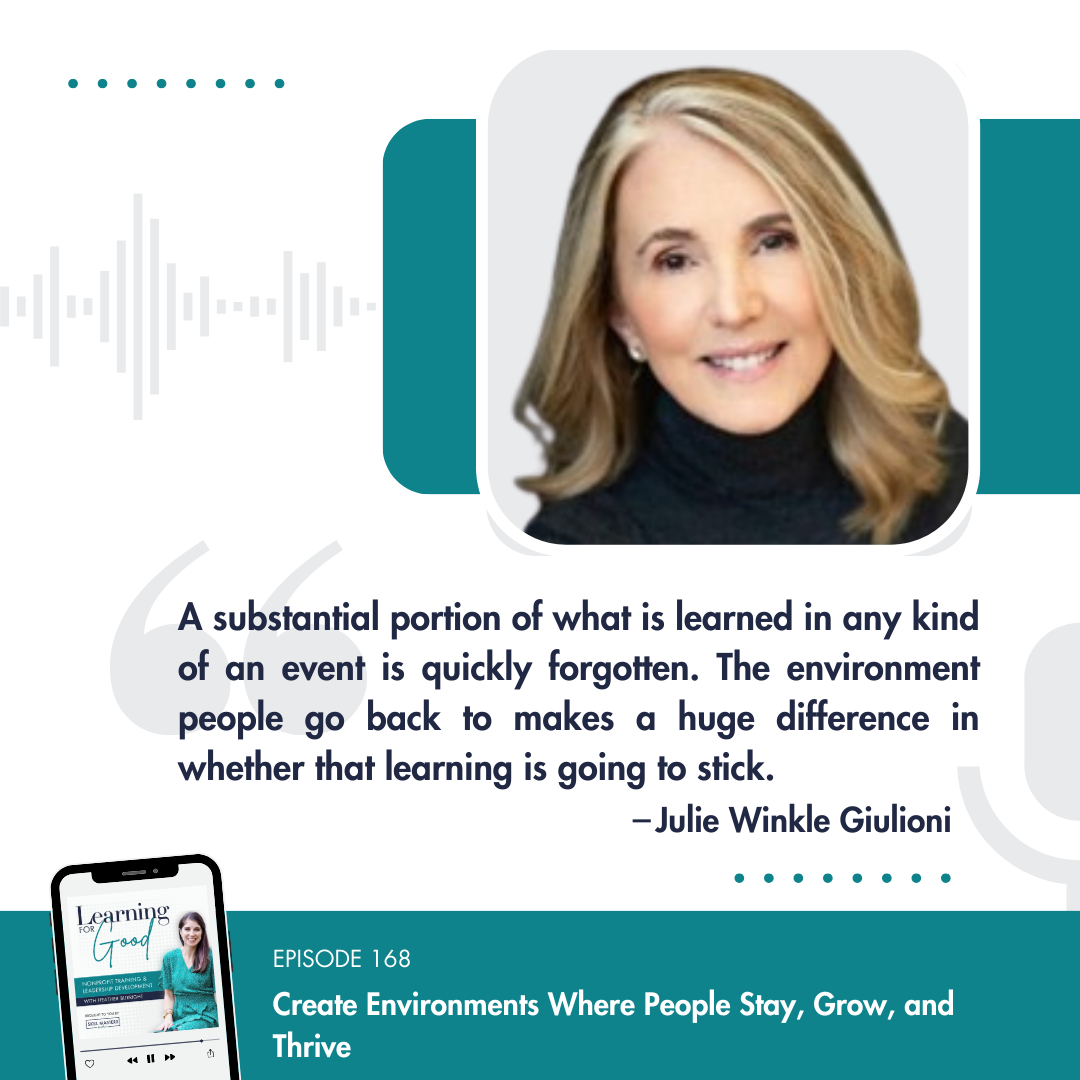
Research is clear: a substantial portion of what is learned in any learning event is quickly forgotten. The environment people go back to makes a huge difference in whether that learning is going to stick.
A manager who dismisses new skills by saying, “We don't have time for that nonsense. Just do the job,” completely undermines the investment in training. We cannot justify the investment if it isn't supported.
Manager support and reinforcement, both before and after any learning experience, has a huge impact on behavior change. As L&D, we can beef up those “bookends” to ensure that our efforts deliver the greatest return on investment (ROI).
Three Components of the Learning Ecosystem
When we consider development, we are dealing with a complex ecosystem involving three key players:
The Individual: This person must make the commitment to learn as others cannot learn for them.
The Manager/Leader: Their role is to support the individual’s growth by creating the conditions that allow the staff member to make the desired changes.
The Organization (L&D, HR, Culture): The organization creates the systems, structures, and enablement necessary to make growth happen.
When these three elements are in sync and aligned, behavior change is truly possible.
While L&D often attempts tactics like “manager contracts” or lunch and learns to ensure support, these can sometimes reduce the manager's role to a mere responsibility or another task to check off their long list. These tactics, though well-intentioned, do not necessarily impact the overall environment.
How People Managers Support Training and Behavior Change
The Shift: Responsibility vs. Relationship.
The key difference between high-performing managers and others is a profound mindset shift:
Those [managers] don't see development as a responsibility, but rather as a relationship.
Effective leaders are talent magnets because their commitment to the growth of others comes from their core, playing out in consistent ways. They create the psychological safety necessary for growth. Learning is risky business; doing something new is often one step forward and two steps back. If staff do not trust that their boss “has their back,” especially in today's pressure cooker environment, there is little incentive to take risks and put new skills into practice.
Training People Managers to Build High-Performing Teams
The good news is that this supportive environment, while rooted in mindset, can be deconstructed into replicable behaviors that L&D can teach and reinforce.
Here is what the manager-as-developer relationship looks like in action:
Make it a Continuous Conversation.
The relationship plays out through ongoing dialogue. Development should not be a once-a-year event tied to an Individual Development Plan (IDP); it needs to be a living document. Managers should include discussions of learning and growth in their one-on-ones, perhaps even starting the conversation with questions like, “What have you learned over the last week or two?” or “What’s most interesting to you these days?” This ongoing thread of conversation signals a genuine commitment to the staff member's growth.
L&D can encourage people managers to be in continuous conversation with their staff.
Recognize Progress.
People need to feel like they are moving forward—this is known as the progress principle. Growth and learning are often not overnight transitions. By pausing to offer feedback and coaching, managers help staff recognize the progress they are making, which is essential for sustained motivation.
L&D should emphasize the importance of people managers recognizing progress in their staff’s growth.
Carve Out Time.
This is the most critical resource managers must provide: time. We often say learning is important, but we fail to back that up by giving people the time to make it happen. Carving out dedicated time for learning and application reinforces its importance.
L&D has to make the case for people managers to carve out time for learning and growth.
Provide Opportunities for Learning in the Flow of Work.
The most effective developers of others view life day in and day out as a rich laboratory for learning. They see opportunities to match the work that needs to be done with the growth that needs to happen. This allows people to learn in the workflow while still contributing meaningfully to the organization's mission, creating a sustainable, virtuous cycle for development.
L&D can partner with people managers and offer ideas about learning in the flow of work.
How Learning and Development Can Create This Strong Learning Culture
So, in addition to supporting people managers, how does L&D operationalize this supportive environment, transforming managers from passive signers of contracts to active environment builders?
Build the Business Case
Leaders need to understand the vital role they play; it's often news to them. L&D must build a strong business case by connecting support for learning directly to organizational results, such as retention, engagement, or donor revenue. When leaders understand that their efforts will reduce turnover or result in greater revenue per donor, it captures their attention and encourages them to prioritize the supportive role.
Leverage AI as a Hip Pocket Coach
This is where technology offers exciting new possibilities. The contemporary model for learning operates at the speed of business, often embedding information directly into the workflow. AI can be leveraged as a “hip pocket coach” for leaders. For example, a leader could feed information about an employee into an AI tool and get real-time, curated ideas on how to structure a development conversation or suggest relevant development experiences. This saves managers time and provides them with the nudge and partnership they need in the moment.
Redesign Formal Training for Reinforcement
The time we do have together in formal training (the “golden moments”) can be re-imagined. We don't need to cram it full of the same content that can be delivered through other means. Instead, L&D can use that time for community building, rehearsal, and providing feedback—the activities we know translate into behavior change out on the job. This shift changes how L&D designs, moving the focus from content delivery to active reinforcement.
The Future of Learning & Development
Nonprofit leaders are fortunate to have staff and employees already deeply committed to the mission. The key to success is tapping into that same commitment and using it as the nudge to ensure commitment to the learning that sustains important results.
We must expand what learning and development looks like, moving beyond the isolated training event to a holistic culture. This requires helping leaders understand their absolutely vital role both before and after formal learning, as well as their role in finding informal opportunities for growth.
If we can help leaders create these crucial moments, reinforce learning, and help people sustain change, we become more effective as an L&D department, showing better results across the organization.
To learn more about tapping into people managers to sustain learning and create a strong learning culture, tune into episode 168 of the Learning for Good podcast.
Additional Resources Just for You
Other Helpful Podcast Episodes:
Subscribe to the Nonprofit L&D Insiders.
Join the Nonprofit L&D Collective.
Support the Learning for Good Podcast
Become a sponsor.
Ask a question or suggest a topic.
We love hearing from listeners!
Leave a review.
Reviews teach us what content resonates most and help us reach more people!