Why Staff Training and Development Drives Nonprofit Success
How do you get your CEO to see staff development as central to your nonprofit's success rather than something that is nice to have?
In this episode of Learning for Good, I sit down with Elizabeth Cushing, CEO of Playworks, to explore how a nonprofit CEO thinks about learning and development and staff training and development.
In nonprofits, resources always feel finite, and staff development often loses out to more urgent priorities, even for leaders who believe deeply in their people.
However, if your organization is a body, learning is the nervous system, and that makes investing in your people central to your mission.
Key Points:
00:00 Learning Is Central to Your Nonprofit's Success
03:21 Elizabeth's Nonprofit Background
07:44 How Playworks Brings Play into Schools
09:38 How Learning and Staff Development Drive the Playworks Mission and Strengthen Their Organization
17:44 Why Staff Development Deserves Finite Nonprofit Resources
20:53 What Makes L&D a Strategic Partner in Achieving Goals
23:42 Advice for Nonprofit CEOs Juggling Competing Priorities
Why Learning and Development Is Central to Nonprofit Strategy
I want you to think about your organization like a human body.
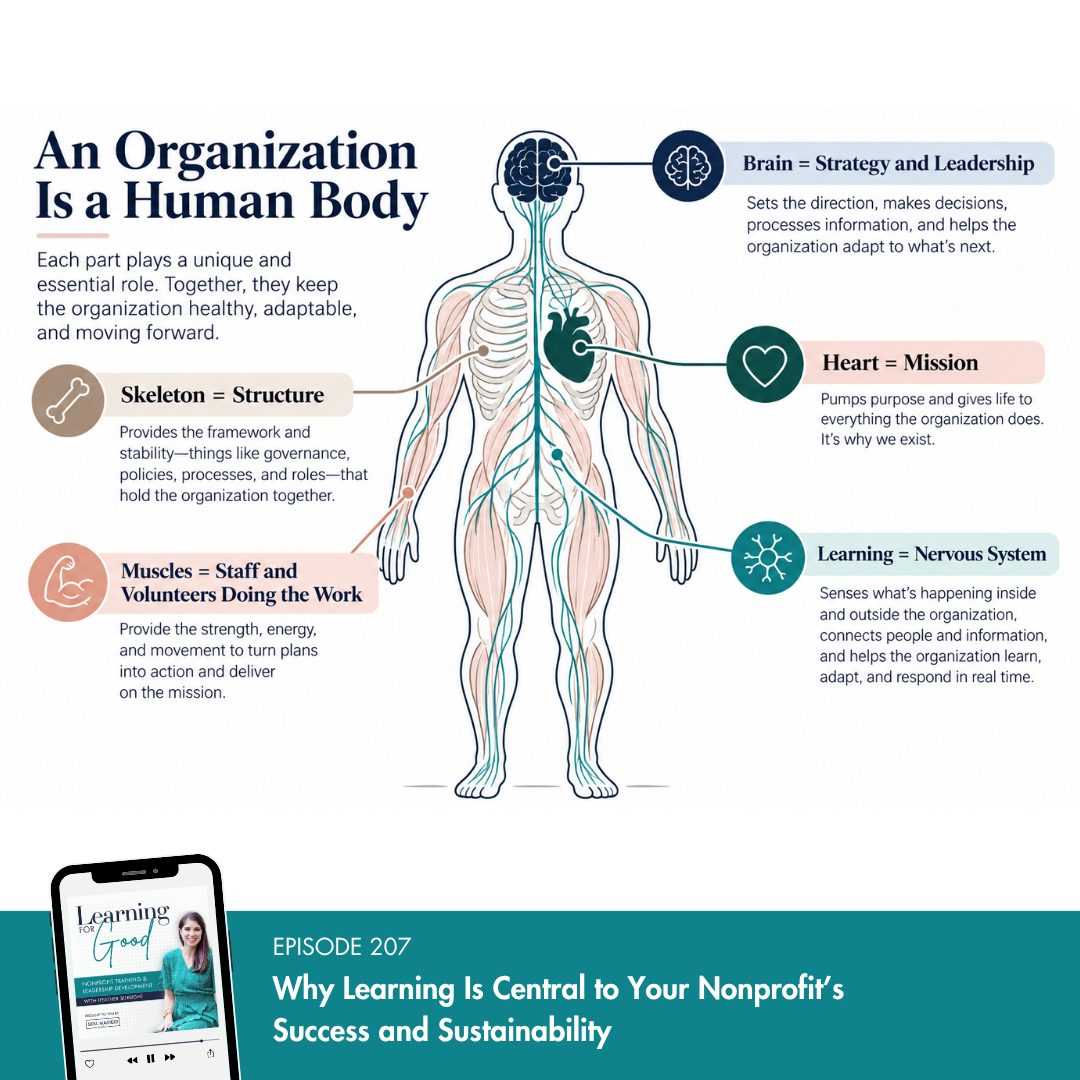
Your strategy and leadership are the brain. Your systems and structures are the skeleton. Your staff and volunteers are the muscles doing the work. And your mission is the heart that gives all of it meaning.
But something still has to connect those parts.
That’s where learning comes in.
I think of learning as the nervous system because it helps translate intention into action. Your strategic plan can say that you want to expand, improve program quality, develop new partnerships, or create a stronger leadership pipeline. Your people still need the knowledge, skills, behaviors, and support required to make those things happen.
That is one reason I wanted to talk with Elizabeth Cushing.
As CEO of Playworks, Elizabeth has helped lead the organization through significant growth. And when she talks about staff development, she connects it directly to what the organization needs its people to be able to do.
For frontline staff, learning includes understanding not only what Playworks does with children, but why specific practices matter.
For employees moving into management, it means learning how to give feedback, support other people, and know when to lean in and when to step back.
And as Playworks builds more partnerships with organizations such as YMCAs, Boys & Girls Clubs, and Camp Fire, the organization needs employees who can develop those partnerships effectively.
The learning changes because the strategy changes.
How Staff Development Supports Your Organization’s Investment in People
Nonprofit leaders are constantly deciding how to use limited time and resources. Elizabeth approaches those decisions with what she called a business lens.
At Playworks, more than 80% of organizational expenses are salaries and benefits. That makes people a significant financial investment.
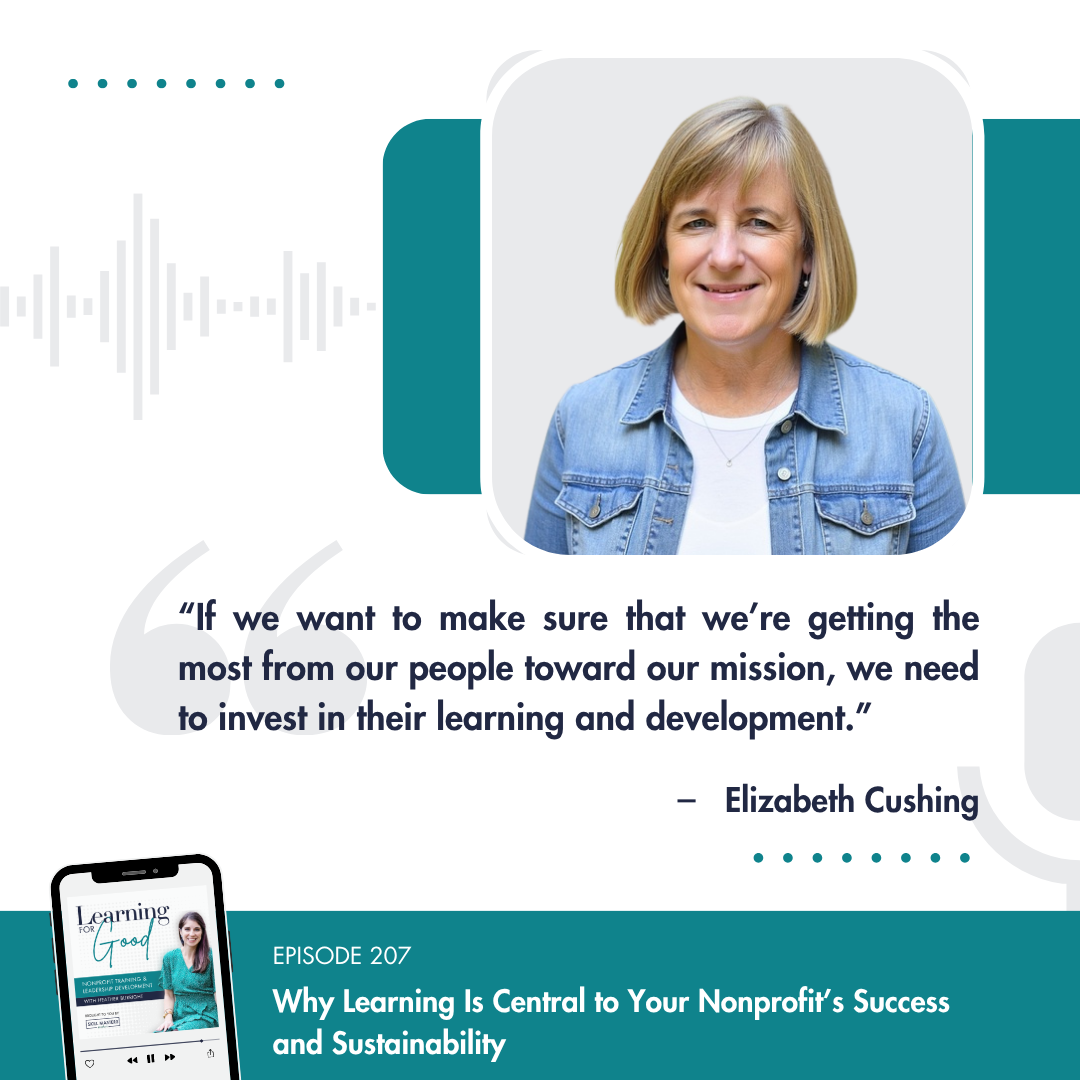
Her question is essentially: How do we make the most of that investment toward the mission?
Learning and development is part of the answer.
If your organization depends on people to provide services, build relationships, manage programs, raise revenue, lead teams, and adapt to changing conditions, developing those people supports work the organization has already committed to doing.
Elizabeth also talked about retention, but she made an important distinction. Retention can be one outcome of investing in staff, but for her, the strongest business case begins with the mission and what the organization is trying to accomplish.
That’s useful for L&D leaders because different stakeholders care about different outcomes.
An HR leader may immediately understand the retention or engagement argument.
A CEO may be listening for program quality, growth, capacity, revenue, or mission performance.
It’s important to know who you are talking to and what they care about, so you can adapt your message.
How Leadership Development Builds Nonprofit Capacity and Career Pathways
One of my favorite examples from Elizabeth was Playworks’ emerging-leaders program. Playworks has a strong commitment to promoting from within. Being great at your current job gives you an important foundation. Moving into management adds a different set of responsibilities and skills.
Suddenly, success isn’t only about your own performance. You’re encouraging other people, giving feedback, making decisions, coaching, and figuring out when to intervene and when to give someone room to work.
Playworks recognized that employees could be better prepared for that transition with intentional development.
So the organization created a cohort experience for emerging leaders.
Initially, Playworks partnered with an outside organization to facilitate the program. Employees participated in an in-person experience, applied what they were learning in their own work, and returned to share what they learned and ideas for improving the organization.
Then Playworks began building its own internal capacity.
Its staff started facilitating alongside the external partner so the organization could learn how to run the program itself. Eventually, they brought it in-house.
Elizabeth has watched participants move into manager and director roles and remain with the organization. She has also seen younger employees recognize the program as a visible pathway for their own growth.
That’s capacity building.
The organization is strengthening today’s talent while also preparing people for tomorrow’s responsibilities.
How Strategic L&D Partnerships Support Organizational Goals
I asked Elizabeth what she needs to see from HR and learning and development before she views them as strategic partners.
Here’s what she shared:
At Playworks, the people team is asking what the organization needs to get better at in order to achieve its long-term vision.
That might mean asking what a particular group of employees needs to be able to do that they aren’t fully prepared to do yet.
It might mean considering how L&D should support revenue growth.
It might mean recognizing that different parts of the country or different revenue streams require different capabilities.
The starting point is the organizational issue. Then the people conversation follows.
For L&D leaders, that may mean spending more time understanding the strategic plan, talking with leaders outside of HR, and learning how the organization actually operates.
The better you understand where the organization is headed, the better positioned you are to anticipate what its people will need.
How Nonprofit Leaders Can Identify Learning Needs Closer to the Work
Elizabeth also offered a useful suggestion for nonprofit CEOs who care about developing staff while balancing a long list of priorities.
Talk to people closer to the work. Not only the senior leaders you talk with every day. Talk with a program director who understands the finances and also sees what employees and teams are experiencing.
Ask what gets in the way of high-quality programming.
Ask what keeps them up at night.
Ask for a specific example.
Then follow it.
Elizabeth explained that sometimes a challenge was originally presented to her as one manager’s problem. But if 20 people in that role were experiencing the same barrier, that told her something bigger was happening.
That insight is also useful for L&D leaders.
Sometimes our most valuable needs-analysis tool is a good conversation with the people who can see where strategy and day-to-day work are colliding.
How Nonprofit Talent Development Leaders Can Connect Learning to Strategy
So what can you take from Elizabeth’s CEO perspective and apply this week?
Start with one organizational priority.
Then ask:
What does the organization need to accomplish?
What will people need to be able to do for that to happen?
Where are people currently getting stuck?
Who is close enough to the work to help us understand why?
What kind of development or support could build the capability we need?
Those questions position learning inside the organization’s strategy.
And in an environment where nonprofits are being asked to adapt quickly, scale thoughtfully, use resources responsibly, and continue delivering on their missions, that connection matters.
Elizabeth ended our conversation by talking about the amount of change organizations are navigating right now.
Learning helps people adapt with them. If the strategy changes, people can build new skills. If the organization scales, people can develop new capabilities. If the mission requires a different way of working, learning can help people put that change into practice.
That’s why I keep coming back to the nervous-system metaphor.
Learning helps carry strategy through the organization and turn it into action.
To hear more of my conversation with Elizabeth Cushing, tune into episode 207 of the Learning for Good podcast.
Additional Resources Just for You
Other Helpful Podcast Episodes:
Subscribe to the Nonprofit L&D Insiders.
Join the Nonprofit L&D Collective.
Support the Learning for Good Podcast
Become a sponsor.
Ask a question or suggest a topic.
We love hearing from listeners!
Leave a review.
Reviews teach us what content resonates most and help us reach more people!