If You Want Leadership Buy-In, Stop Talking About Training
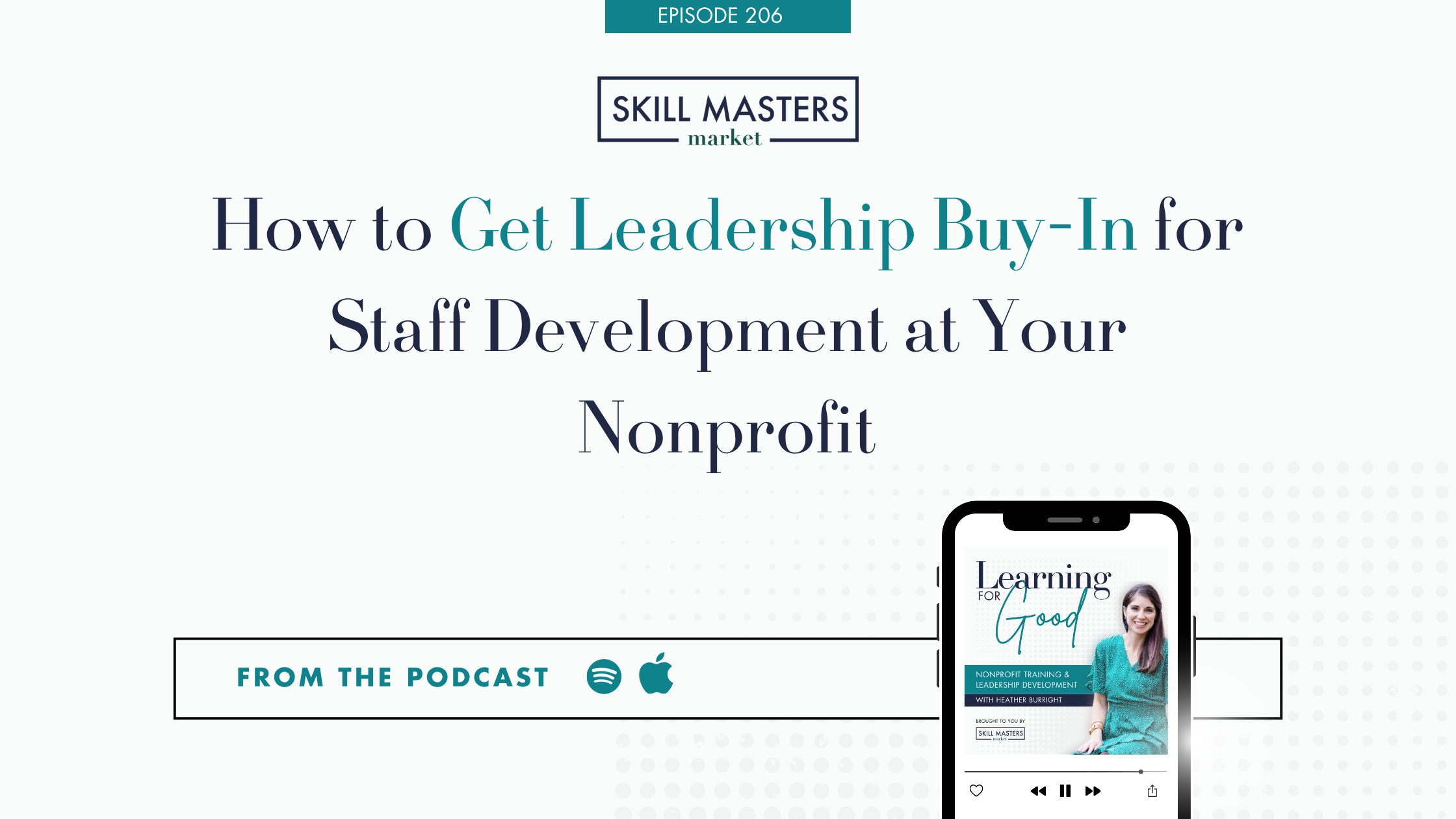
How do you get your CEO, COO, executive director, or board to see why investing in staff is not just important, it's mission critical?
In this episode of Learning for Good, I break down how to get leadership buy-in for staff development in your nonprofit.
The first step is to stop talking about training. Leadership already has a goal in the spotlight, and training isn't it, so pushing it into the conversation just gets you tuned out.
I share how to connect a specific capability gap to the goal leadership already cares about, how to make the risk of ignoring that gap clear, and how to show leadership that their investment is working.
▶️ Key Points:
00:00 Getting Leadership to Invest in Staff Development
05:09 How to Step Into Your Leaders' Spotlight
07:46 Defining Outcomes
08:47 Proving the Investment Is Working
Step Into the Spotlight Your Nonprofit Leaders Are Already In
“If you want leadership buy-in, stop talking about training” probably sounds like strange advice from someone who talks about training for a living, but stay with me.
Let’s say your nonprofit plans to expand into three new communities next year. Your executive team is thinking about funding, staffing, operations, programs, and whether the organization has the capacity to make that expansion work.
Then you come in and say, “We need manager training.”
You may be completely right. You may desperately need manager training. But your leaders are already focused on expansion, and now it can sound like you’re asking them to make room for another priority.
That’s the part I want us to rethink.
I use the image of a spotlight in this week’s episode of Learning for Good because I think it’s a useful way to think about leadership attention.
There are always a lot of things happening across an organization. Your leaders know those things are there, but only a few priorities are getting their full attention at any given time. Maybe it’s expansion. Maybe it’s a new funding opportunity. Maybe it’s improving retention, increasing program reach, or responding to a change in the organization’s strategy.
Whatever it is, that’s where the spotlight is.
Instead of trying to move that spotlight over to manager development, start with the thing that’s already in it.
Using the expansion example, you might say, “As we grow into three new communities, we’re going to have more people leading teams for the first time.”
Now you’re still talking about expansion, but you’ve introduced the people side of making it happen.
From there, you can start asking what those new managers will actually need to be able to do. Can they make decisions without escalating everything to senior leadership? Can they translate organizational goals into clear priorities for their teams? Can they delegate effectively, coach performance, and address people issues?
That gives you a very different starting point than “we need training.” You’re helping leadership see the capabilities the organization will need in order to execute the strategy they already care about.
Show What Happens If Staff Capability Isn’t There
Once you’ve identified what people need to be able to do, the next step is making the gap visible.
This is where we have to get more specific than saying, “Our managers need development.”
What happens if they don’t get it?
Maybe every difficult performance issue ends up with a director or executive because managers don’t feel equipped to handle it. Maybe routine decisions keep moving up the chain because people aren’t confident making them at their level. Maybe teams are working hard, but managers aren’t translating the strategic plan into clear priorities, so all that activity isn’t necessarily moving the organization where it wants to go.
Those are organizational problems.
And they matter because they affect the same goals leadership is already trying to achieve.
If your senior leaders are supposed to be focused on expansion but they’re spending hours every week resolving people issues that could be handled at the manager level, that’s worth talking about. If managers are waiting for senior leaders to make decisions that could be made closer to the work, that affects capacity too.
This is where L&D can help leadership see the connection between a people capability and an organizational outcome.
Talk About the Result Before You Talk About the Training Program
Once the gap is clear, it’s tempting to jump directly to the solution.
“We need a manager development program.”
Maybe you do. But I’d stay with the outcome a little longer.
What do you actually want to be different?
If managers are escalating too many people issues, maybe the outcome is that they handle more of those situations effectively at their own level. If senior leaders are getting pulled into routine decisions, maybe the outcome is that managers make more of those decisions independently and know when something truly does need to be escalated.
Those are things leadership can understand because they connect directly to how the organization operates.
They also give you a much better foundation for deciding what the solution should be.
A manager development program may be part of it. But once you’ve defined the outcome first, you may also discover that managers need clearer expectations, better tools, more reinforcement from their own leaders, or changes in the systems around them.
Starting with the result helps us avoid falling into the trap of assuming training is automatically the answer just because training is the work we know how to provide.
Show How You’ll Know the Investment Worked
If you’re asking leadership to invest in staff development, eventually someone is going to ask how you’ll know whether it made a difference.
That’s a much easier question to answer when you’ve already been clear about the outcome.
Let’s stay with the example of escalations. Before the development work begins, you might look at how many people or performance issues are being escalated to senior leaders and what kinds of issues they are. You could also look at how much leadership time is being spent addressing them.
Then check again later.
Has the number changed after three months? Six months? A year? Are managers handling more situations appropriately at their own level? Are senior leaders spending less time on issues that don’t actually require their involvement?
Not every L&D outcome will give you a perfect number, and I don’t think we should pretend otherwise. But we can still be much more thoughtful about defining what success looks like before we start the work.
That allows us to move the conversation beyond attendance, completion rates, or whether people liked the training. We can talk about whether something changed in the way the organization actually operates.
Training Is the Tool, Not the Goal
This is really the idea I want you to take away.
We don’t need our leaders to care as much about training as we do. We need them to understand what their people need to be able to do for the organization to accomplish its goals.
Our job is to help make that connection visible.
Sometimes training will be part of building those capabilities. Sometimes the answer will be broader than training. Either way, the conversation starts with the organizational outcome, not the program we want to build.
So the next time you’re trying to get leadership buy-in for staff development, start with the priority they already have and ask:
What do our people need to be able to do for this to work?
Then build the conversation from there.
Additional Resources Just for You
Other Helpful Podcast Episodes:
How Nonprofit Training Leaders Can Stop Being Reactive and Start Driving Learning Strategy
Nonprofit L&D Leaders – Your Role Is Much Bigger Than Delivering Training
3 Small Shifts that Increase Your Credibility as a Learning Designer
Subscribe to the Nonprofit L&D Insiders.
Join the Nonprofit L&D Collective.
Support the Learning for Good Podcast
Become a sponsor.
Ask a question or suggest a topic.
We love hearing from listeners!
Leave a review.
Reviews teach us what content resonates most and help us reach more people!