The Real Cost of Performance Problems (and Why Strategic Learning Fixes Them)
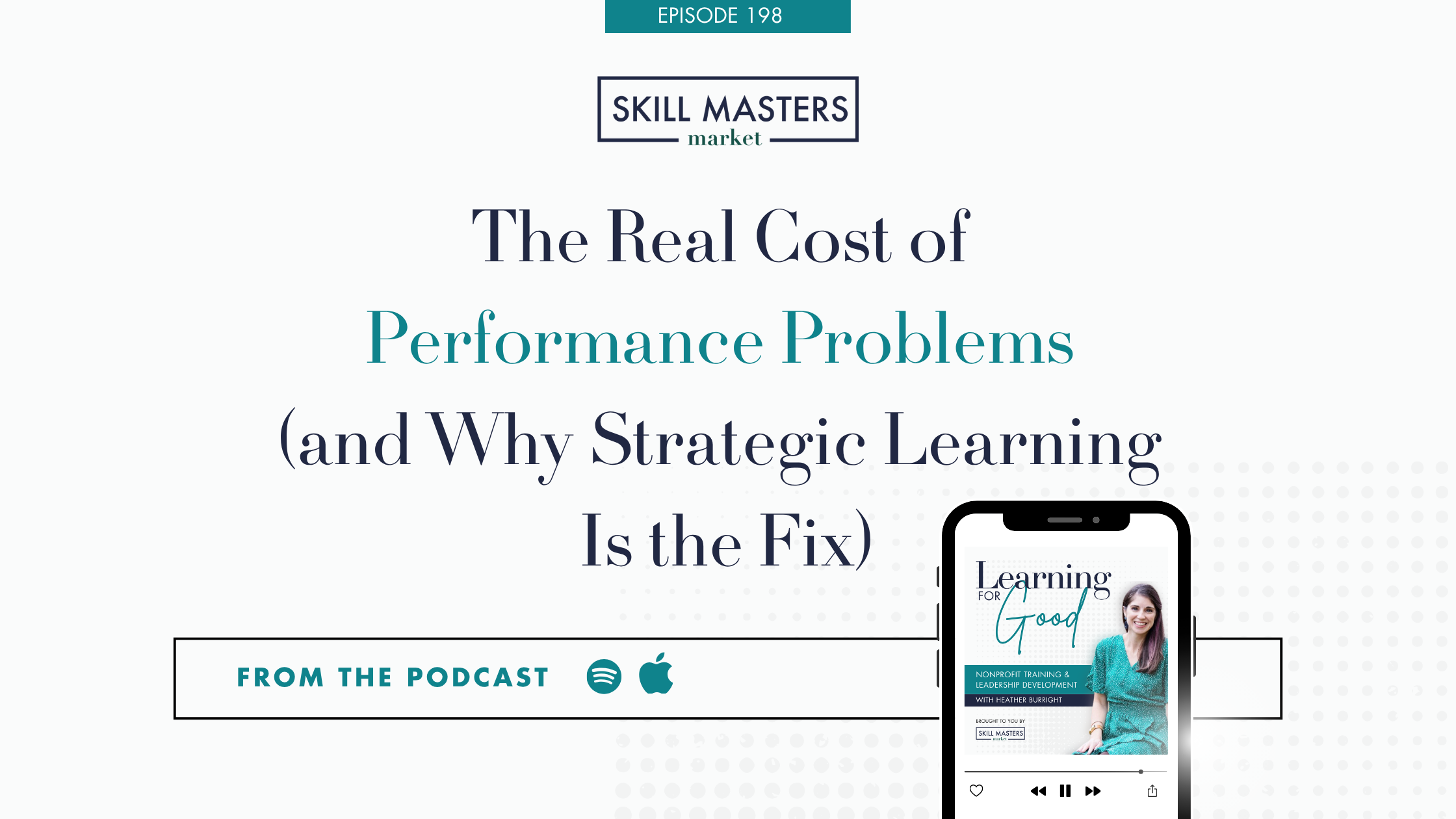
Does your learning and development team spend more time responding to requests than shaping where your organization is headed?
In this episode of Learning for Good, I sit down with L&D leaders Kamaria Scott, Rachel Platt, and Yogi Mueller for a conversation on why nonprofit learning and development teams stay reactive and what it takes to build stronger learning and development strategies.
Too many L&D functions have been reduced to a training factory instead of shaping where the organization is headed. We talk about why this happens even to skilled, well-intentioned professionals and the real cost of staying reactive instead of strategic.
▶️ Key Points:
00:00 Reactive vs Strategic Learning and Development
04:05 Understanding Reactive Learning
06:31 How the L&D Business Partner Role Got Lost
15:25 Learning Becomes Strategic When...
23:06 The Real Cost of Staying Reactive
25:25 One Shift Every L&D Professional Can Make Today
Performance Problems in Nonprofits
Every nonprofit has at least one performance problem it hasn’t named yet. It might be a program manager who keeps missing deadlines, a director everyone knows is struggling, or turnover on a team that leadership keeps chalking up to the market. None of these show up on a budget line labeled “learning gap.” But that’s often exactly what they are, and left alone, they get more expensive, not less.
That’s the basis of my conversation with Yogi Mueller, Rachel Platt, and Kamaria Scott on episode 198 of the Learning for Good podcast.
Nonprofit L&D and HR leaders are in a unique position to see these problems. We sit close enough to the work to notice where performance is breaking down, but we’re not always positioned to act on it before it becomes a bigger, more expensive problem. Add limited budgets, lean teams, and a mission that leaves little room for wasted effort, and the case for catching performance problems early only gets stronger. This post breaks down what reactive performance management actually costs, why so many teams stay stuck in that pattern, and what shifting to a more strategic approach to learning looks like in practice.
The Hidden Cost of Reactive Performance Management
Most L&D functions operate the same way: a request comes in, gets fulfilled, and everyone moves to the next one. It’s efficient on paper. It also means the underlying issue driving the request rarely gets examined.
In my conversation with Rachel, Kamaria, and Yogi, we each came up with our own analogy for this reactive posture. One compared it to a game of whack-a-mole: solve the visible problem, wait for the next one to pop up, repeat. Another described it as constant firefighting, putting out one blaze only to watch another start down the street. A third pictured rusty gears grinding forward, expending a lot of energy without gaining much ground.
The common thread across all three: motion without traction. Reactive L&D teams are busy, sometimes exhausted, and still not closing the gap between where the organization is and where it needs to be.
But staying reactive has a price tag. Rachel shared that a former colleague used to say: you pay either way. You either invest in developing your people ahead of the need, or you pay later, through turnover, disengagement, or a stalled strategic goal.
Reactive organizations don’t avoid that bill of performance management. They just don’t get to choose when it arrives, and by the time it does, it’s usually larger than the investment would have been.
Why Learning Stays Reactive
If reactive learning is this costly, why does it remain the default in so many organizations?
Historically, L&D functions owned the full arc of a project: meeting with a business leader to understand goals, needs, and pain points. Only then, did L&D decide what to create (training or otherwise). Over time, in the name of efficiency, that scoping work got separated from the rest of the process. Organizations ended up with dedicated designers and dedicated facilitators, but nobody whose job it was to ask why the request existed in the first place.
What’s left is an intake form. A stakeholder submits a ticket, L&D fulfills it, and the conversation that used to happen before any building started simply disappears. When nobody owns that step, requests become the entire job, and the function drifts further from the strategic table.
This scoping work is what ties L&D's work to what the business is actually trying to achieve, and without it, even well-designed training solves the wrong problem.
Becoming a Strategic Learning Partner
Being strategic isn’t about picking a fancier title or adding more meetings to your calendar. In the same conversation referenced above, the panelists landed on a simple definition: learning becomes strategic when it’s tied to where the organization is going, not where it’s already been or where it got burned in the past.
That means naming a specific, measurable outcome before deciding on a solution. Not “we need better engagement,” but “we need managers who can retain their teams past the one-year mark.” Not “leadership wants more training,” but “leadership needs a pipeline of people ready to step into director roles within eighteen months.”
Getting there requires L&D leaders to be fluent in the language of the business, not just the language of training. That means connecting a skill gap to a number leadership already tracks, whether that’s retention, service delivery, or program outcomes.
Getting a Return on Your Investment (ROI) from Training
Becoming more strategic only matters if you can eventually show it made a difference. This is where many nonprofit L&D teams stop short. They shift their approach, scope requests more carefully, and tie projects to real outcomes, but never circle back to measure whether any of it moved the needle.
Proof doesn’t have to mean an elaborate evaluation system. It can be as simple as tracking the specific metric you named when you scoped the project in the first place. If the goal was reducing first-year turnover on a program team, that’s the number to watch three, six, and twelve months later. If the goal was building a bench of ready leaders, track how many internal candidates are qualified for the next open role when it comes up.
This is also where the difference between activity and impact becomes visible. Completion rates and satisfaction scores tell you people showed up. They don’t tell you whether performance changed. Strategic learning leaders build the connection between the two directly into the project from the start, so proving impact isn’t an afterthought tacked on once someone asks for results.
To learn more about how learning can be a strategic lever for your nonprofit, tune into episode 198 of the Learning for Good podcast.
Additional Resources Just for You
Other Helpful Podcast Episodes:
Subscribe to the Nonprofit L&D Insiders.
Join the Nonprofit L&D Collective.
Support the Learning for Good Podcast
Become a sponsor.
Ask a question or suggest a topic.
We love hearing from listeners!
Leave a review.
Reviews teach us what content resonates most and help us reach more people!