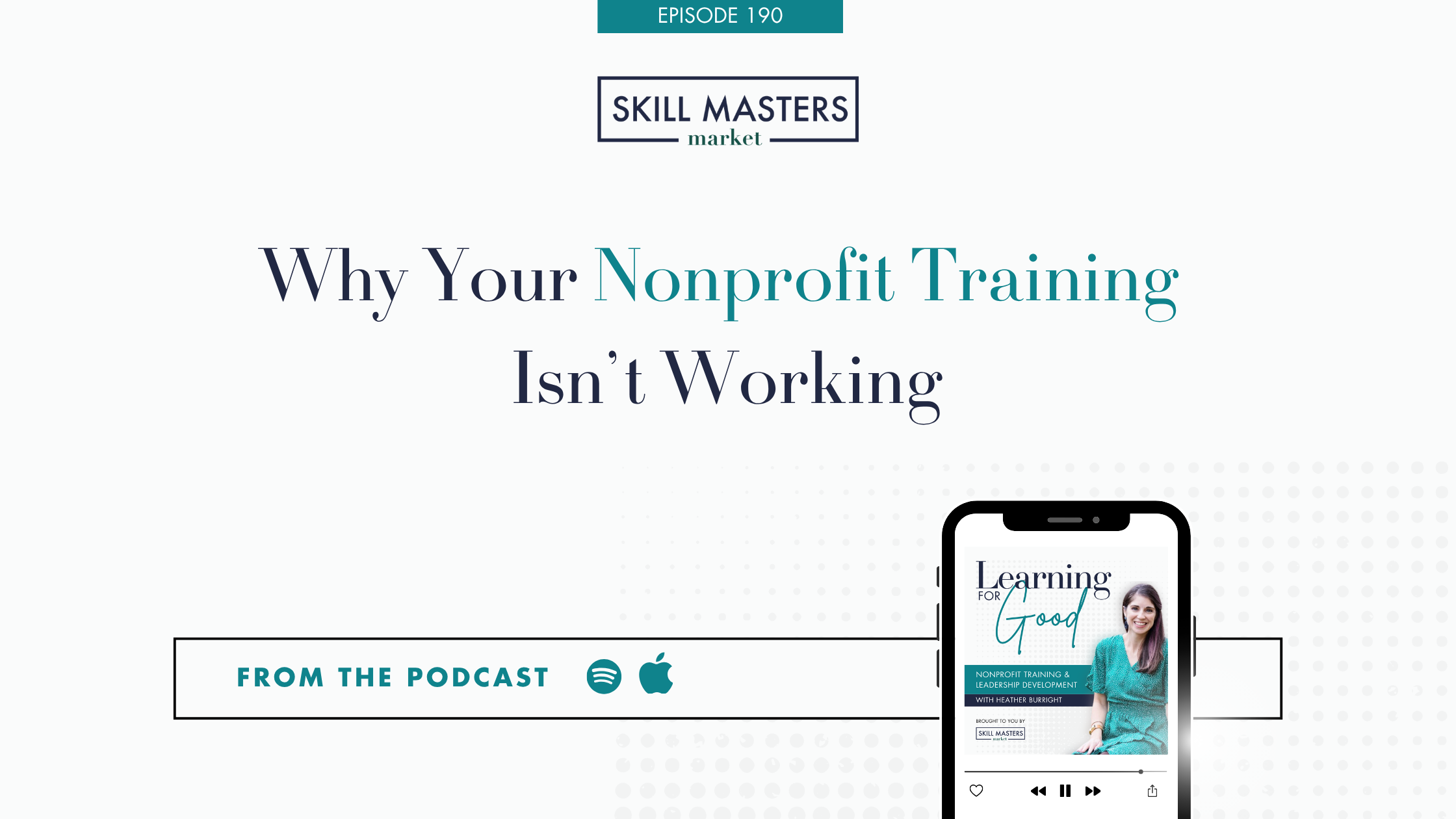
Why Your Nonprofit Training Isn’t Working
You invested time and resources into staff training and development, but your team still isn't applying what they learned. Why? Many nonprofit leaders focus heavily on what employees need to learn and how they should learn it. While those elements are essential, they're only part of the equation.
In this episode of Learning for Good, I’m exploring why even well-designed training programs often fail to create lasting behavior change. True success happens when training translates into consistent action on the job.
I’m sharing five overlooked factors that determine whether learning becomes performance improvement or simply another forgotten workshop.
▶️ Key Points:
00:00 Why Great Training Doesn't Always Lead to Action
05:07 5 Factors Preventing Behavior Change
14:12 Designing Training That Drives Lasting Behavior Change
Why Didn’t Your Training Work?
You built the training. You got buy-in. You delivered it well. And then... not much happened.
Sound familiar?
This is one of the most frustrating experiences in nonprofit learning and development. You did the work—and we’re talking real work, not just slapping together a slide deck—and somehow behavior on the job looks exactly the same as it did before. People are reverting to old habits. The same problems keep surfacing.
The training was good, but training is only part of the solution.
You have to account for how people change behavior and design a set of solutions that support that change. And that’s what I’m talking about on episode 190 of the Learning for Good podcast.
Timing: Knowing When to Implement a New Skill or Behavior
This one might catch you off guard because it’s subtle. Your learners leave the training with the skill. They can demonstrate it. They can explain it back to you. But when they’re on the job, they can’t figure out when to apply it.
Think about it like navigating an unfamiliar intersection. You know the general rule: stop at the stop sign. But, if you approach an unfamiliar intersection and you’re looking around at five crossing streets, unclear which direction has the right-of-way, and unsure where exactly to stop. So you hesitate.
An example I’ve seen: training managers to coach. A manager attends the training, learns how to coach, practices the technique, and feels ready. Then they’re sitting across from a direct report who’s underperforming, and the question hits them: Is this a coaching moment? Or should I just give direction? Is this a discipline situation? They can’t answer that fast enough in the moment, so they do what they’ve always done. They give direction. Not because they don’t know how to coach, but because no one taught them when to coach.
The fix? Build cue recognition directly into your training design. Don’t just teach the skill; teach learners to identify the situations that call for it.
Motivation: Understanding Why a New Skill or Behavior is Important to Change
Training without the “why” is like handing someone a map with no destination. They’ll follow it for a while, but the moment it feels inconvenient, they’ll put it down.
When learners don’t understand why a behavior matters, consistency disappears. The behavior becomes optional in their mind, especially when things get busy.
Data entry is a perfect example. You train your staff on how to enter donor data into the system. The process makes sense to them. But if they don’t understand how incomplete or inaccurate data affects donor stewardship, reporting accuracy, grant compliance, and ultimately funding, it starts to feel like administrative busywork. And busywork gets deprioritized.
When your learners understand the downstream impact of the behavior you’re asking for, they start to make the connection between their individual actions and the mission outcomes your organization is accountable for. That’s when training starts to feel relevant, not just required.
Prompts: Helping Learners Remember to Implement the New Behavior
Knowledge doesn’t automatically translate into habit. Remembering to do something new, in the middle of a full and often chaotic workday, is genuinely hard.
Think about any time you’ve been so caught up in thought during a familiar drive that you couldn’t remember how you got somewhere. You knew the route. You were capable of following it. But your brain was occupied elsewhere, and the familiar autopilot took over.
Here’s a relevant nonprofit example: trauma-informed care training. Staff and volunteers are trained in trauma-informed approaches, they understand the principles, and they genuinely want to use them. But when tensions rise on the job—a difficult interaction, an emotionally charged moment, a stressful shift—they fall back on old habits. Not because the training failed. Because the conditions required them to consciously remember to do something new, and in that moment, they simply didn’t remember.
This is where reinforcement structures matter: job aids, supervisor check-ins, practice opportunities, team discussions after the training ends. Solutions like this become the mechanism by which new learning becomes default behavior.
Environment: Making It Easy to Implement the New Behavior
Your training happens under optimal conditions. Even when you try to simulate real-world challenges, the training environment is fundamentally different from the job environment, and that gap matters more than most people realize.
When learners return to their actual roles, they may encounter processes that don’t quite match what they practiced, physical environments that don’t support the new behavior, or supervisors who don’t reinforce the change. Any one of these can be enough to derail implementation.
Consider a customer service training where staff are taught how to greet the people they serve with warmth and presence. In the training room, that’s easy. Back on the floor? They’re completing mandatory incident documentation, the phone is ringing, a colleague needs something, and their supervisor is hovering. The intention is there. The skill is there. But the environment is working against them.
This is the part of the performance problem that lives outside the training room entirely, and it’s why strong nonprofit L&D professionals have to think beyond content design. They have to look at the full performance system and be willing to name the barriers that exist upstream of the training itself. That conversation requires influence, which means the most impactful thing you can do is get closer to stakeholders before the training is designed.
Reinforcement: Supporting Learners as They Sustain the Change
Behavior that doesn’t get reinforced tends to fade. If a new behavior feels neutral at best and inconvenient at worst, people will drift back toward what’s familiar.
This doesn’t mean you need to hand out trophies for every task completed. But there needs to be something—some form of meaningful feedback that signals: this matters, what you did was noticed, it made a difference.
Maybe it’s a manager acknowledging the change. Maybe it’s metrics that make the impact visible. Maybe it’s an opportunity to mentor a peer or share what’s working.
One example that comes to mind: AI adoption. For an AI adoption initiative, the reward might be showing someone the time they just got back in their week or creating a space where people can share what they’ve built with generative AI tools and be recognized for it.
Without this, you’ll often see behavior improve for a few weeks after a training session, then quietly return to baseline.
Diagnosing the Barriers to Workplace Behavior Change
If behavior didn’t change, it might not be the training’s fault. Resist the urge to redesign it from scratch. Instead, use these questions as a diagnostic to find the point of breakdown.
Was the problem knowledge and skill? > Training
Or was it timing, motivation, memory, environment, or reinforcement? > Some other solution
This is the difference between being an order-taker who produces content and a strategic partner who solves performance problems. You don’t need a leadership title or a seat at the table to have this conversation.
That’s what makes nonprofit L&D a leadership function, not a support function.
We are uniquely positioned to create change.
To learn more about the barriers to workplace behavior change, tune into episode 190 of the Learning for Good podcast.
Additional Resources Just for You
Other Helpful Podcast Episodes:
Subscribe to the Nonprofit L&D Insiders.
Join the Nonprofit L&D Collective.
Support the Learning for Good Podcast
Become a sponsor.
Ask a question or suggest a topic.
We love hearing from listeners!
Leave a review.
Reviews teach us what content resonates most and help us reach more people!