How Training Can Reduce Staff Turnover in Your Nonprofit

It's estimated that organizations spend somewhere between 50% to 200% of an employee's annual salary to replace them, depending on the level and complexity of their role.
Not only that, when someone leaves, it impacts morale, our organization, and ultimately our mission. So, it benefits nonprofits to keep our employees.
In this episode, we talk to Rachel Platt, an HR leader and people strategist with over 20 years of experience who helps nonprofits think through their entire talent lifecycle from hiring to exiting.
We are exploring the reasons behind the seemingly normal high turnover in the nonprofit sector, the role of learning and development in reversing this talent loss, how to use this to get buy-in, and low-cost ways to develop and engage your staff.
▶️ Key Points:
08:45 What's really behind high nonprofit turnover
12:59 Low-cost ways to develop your staff
17:55 The far-reaching benefits of training your staff
24:06 How to get training buy-in from a retention POV
29:04 What the best learning leaders are doing
Training and Development as a Driver of Staff Retention and Performance
If you are a nonprofit leader, you know the persistent challenge: your organization is growing, but your people sometimes aren’t keeping up. You might find yourself fixing the same performance issues repeatedly, wondering how to build staff who are confident, capable, and know how to lead rather than just execute. For many in Learning and Development (L&D), this manifests as a specific problem: you are overwhelmed with projects while nobody respects that good training takes time.
When a staff member leaves for good, they rarely put in the meticulous effort required to ensure those left behind have what they need. Instead of a smooth transition, teams are left scrambling to figure out how to log into systems, follow processes, or deliver essential services. This doesn't just impact a single department; it creates a ripple effect that damages morale, quality, and ultimately, your mission.
In the latest episode of the Learning for Good podcast, I sat down with Rachel Platt, an HR leader and people strategist with over 20 years of experience, to discuss how we can move from being a "training factory" to a strategic partner that drives retention and performance.
The Cost of Staff Turnover in Nonprofits
Many nonprofit L&D professionals feel like they are being treated as a factory, expected to “just create what I say” overnight. I have empathy for this position because I know what it feels like to have your capacity strained by unrealistic expectations. However, the data shows that ignoring the strategic side of development is a massive financial risk for your organization.
It is estimated that replacing an employee costs between 50% to 200% of that person’s annual salary, depending on the complexity of their role. For a mid-size organization, losing a single employee with a $60,000 salary could result in a loss of $30,000 to $120,000 when you factor in both hard and hidden costs.
These costs include:
Recruitment of new employees
Onboarding and initial training
The time it takes for a new hire to reach full productivity
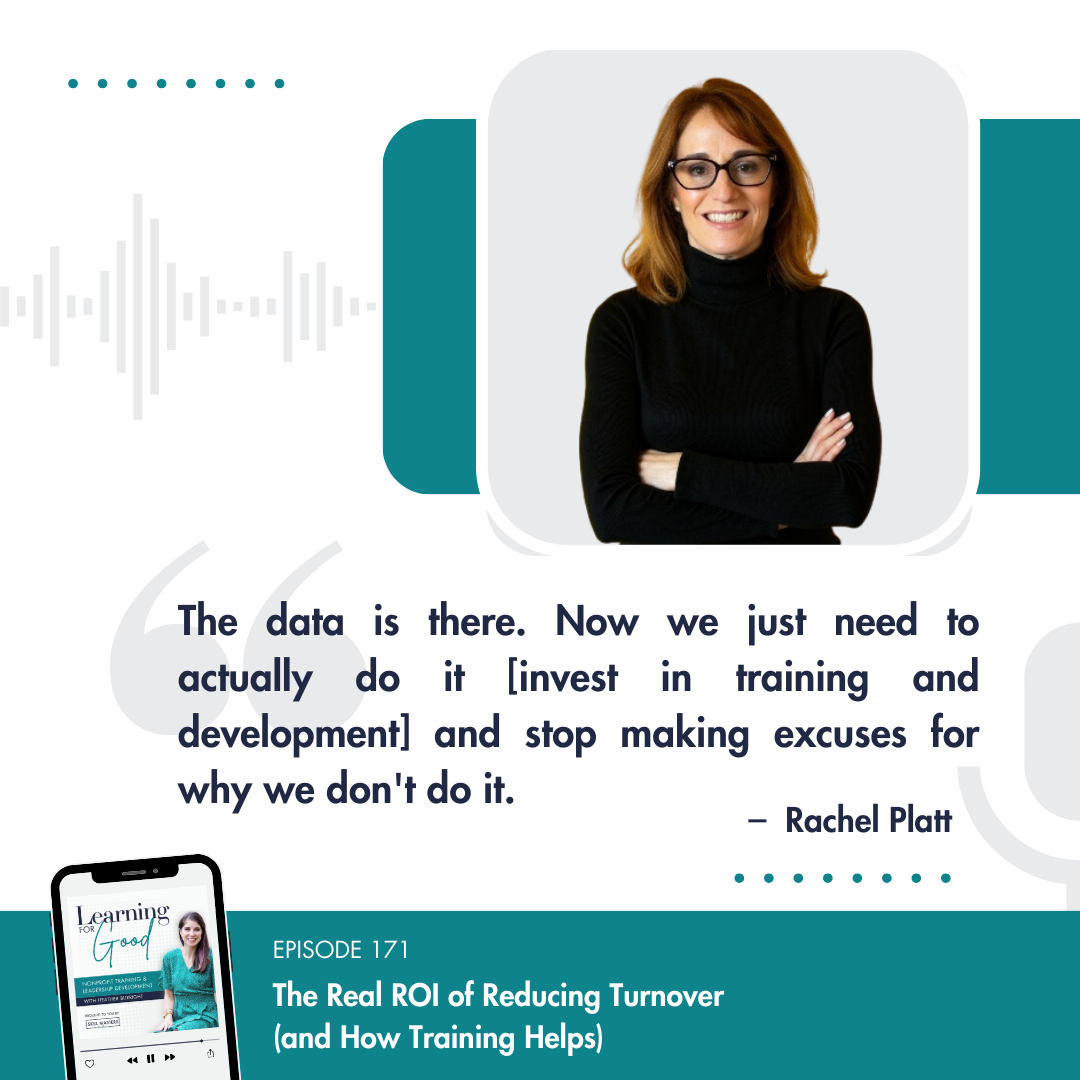
Despite these staggering numbers, the nonprofit sector often feels that high turnover is simply the norm. Rachel Platt argues that we must stop brushing off what departing employees are telling us. When people leave, they are “voting with their feet” and signaling that there is something essential they aren't getting from the organization.
Why Staff Turnover Happens
A common excuse for turnover in nonprofits is compensation. Leaders often blame low salaries. However, as Rachel shares, exit interviews and stay interviews with top talent reveal a different story. While compensation matters, staff rarely cite dollars as the primary reason for leaving.
Instead, they focus on three core questions:
Do I feel valued?
Am I contributing?
Am I learning?
The data from Gallup highlights a crisis of engagement: only 31% of US employees are actively engaged at work, the lowest level in over a decade. This is critical because disengagement is the ramp to turnover. Conversely, when teams are highly engaged, their productivity increases and turnover drops by nearly 50%.
How Learning & Development Can Solve Staff Turnover
To solve this, L&D needs to become a collaborative partner (or nonprofit leaders can contract with an external provider like Skill Masters Market) who can deliver a robust needs analysis and science-backed learning materials that the organization can own and reuse. This moves the L&D away from reactive “order-taking” and toward a strategic investment in employee development.
Low-Cost Ways to Develop Your Nonprofit Staff and Increase Retention
Many nonprofits are afraid of the costs involved in training and development, but strategic investment does not always require a massive budget. As Rachel notes, it can also mean an investment of time and an investment of thought.
If a staff member expresses a desire to learn a new skill, such as fundraising, you don't necessarily need to pay for an expensive external course. For other low cost opportunities, you might offer internal opportunities for growth:
Exposure: Assign the staff member to a specific project that gives them exposure to the desired skill.
Application: After the project, have them present what they learned to the rest of the team during a staff meeting.
Visibility: This shows the employee they are heard and valued, while simultaneously building the organization's internal capacity.
Additionally, you can tap into your people managers for support and reinforcement. This aligns with what we know about behavior change and creates a learning culture within the organization.
Practical ways to do this include:
Providing managers with a single, high-impact question to ask at a staff meeting two weeks after a training session.
Creating an environment where people can continuously learn and grow through informal support.
Encouraging managers to value the learning by showing they believe the skills are vital to the organization's success.
For more ideas about engaging the managers in employee development, check out my conversation with Julie Winkle Giuloni.
How Learning & Development Can Show Up More Strategically
L&D transitions to a confident, strategic leader when they have strong relationships with their stakeholders, a clear picture of the business need, and the data to prove the value of their work.
Historically, L&D professionals haven't used as much data as they could, but that is changing.
To create buy-in for L&D work, you must speak the language of Return on Investment (ROI).
You can pull statistics on:
Retention and Turnover: Show how training correlates with people staying longer.
Promotions: Track how internal development leads to staff being ready for higher-level roles.
Performance Metrics: If you train staff on a specific skill, such as AI or fundraising, measure the results six months or a year later to see the impact on the bottom line.
Even if you don't have a baseline today, start building that data now so you can use it to influence and persuade your leadership to reinvest back into training and development.
When you can show that your programs drive the mission forward, you gain the strategic expertise and respect you deserve.
The end result of this strategic shift is an organization with increased capacity, more confident leaders, and hard proof that your training programs create real change. This goes beyond just the immediate needs of the nonprofit; it touches on the very mission of the sector.
Overcoming Objections to Training Investments
Rachel Platt shares a powerful mindset shift for leaders who fear that if they invest in staff, those staff members will just leave. She references the idea that the only thing worse than training employees and having them leave is not training them and having them stay.
Rachel argues that as nonprofit leaders, our job is to put people back into society better than they came to us. If an organization wasn’t the right fit, but the employee leaves with more skills and a positive impression of your brand, you have still fulfilled a portion of the nonprofit mission. That person becomes a better member of society, a potential future donor, a volunteer, or a brand ambassador who tells others about the great experience they had.
Staff turnover is a reality in the nonprofit sector, but it doesn't have to be an inevitable drain on your resources. By moving away from the "training factory" model and adopting a strategic, data-driven, and human-centered approach to development, you can increase retention, boost engagement, and prepare your people for internal promotion.
When you invest in learning and development, you aren't just checking a box; you are leveraging training to drive performance, improve capacity, and fuel your mission impact. It is time to start proving the undeniable value that strategic L&D brings to the table.
To learn more about L&D’s role in reducing staff turnover, tune into episode 171 of the Learning for Good podcast.
Additional Resources Just for You
Other Helpful Podcast Episodes:
Beyond a Cost: Why Training is THE Strategic Lever in Your Nonprofit
How L&D Pros Can Share ROI and Speak the Language of the Business
Building a Learning Strategy to Support Your Succession Plan
Subscribe to the Nonprofit L&D Insiders.
Join the Nonprofit L&D Collective.
Support the Learning for Good Podcast
Become a sponsor.
Ask a question or suggest a topic.
We love hearing from listeners!
Leave a review.
Reviews teach us what content resonates most and help us reach more people!