How Learning & Development Professionals Can Use Personal Branding to Gain Influence
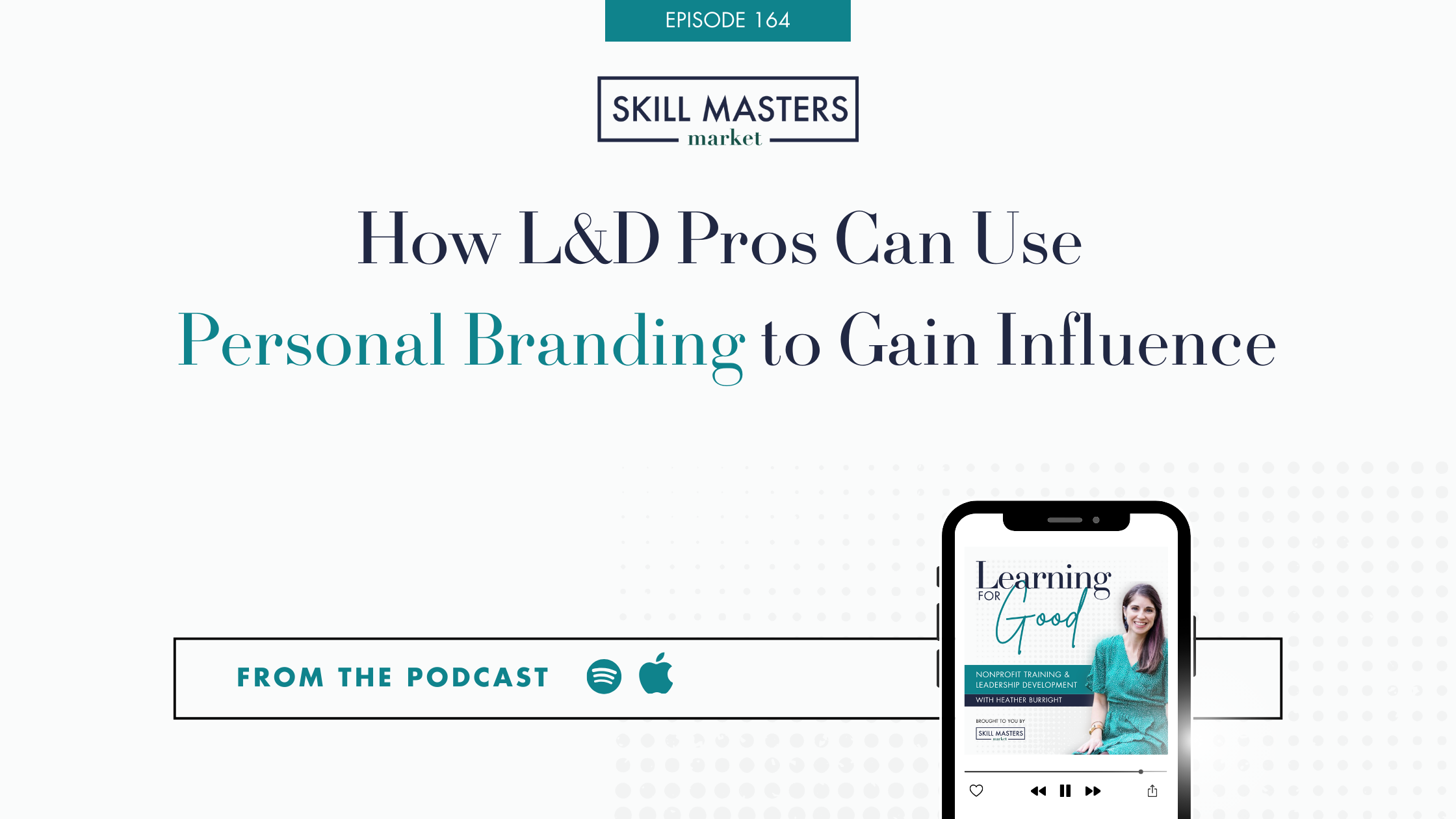
Are you an HR leader or L&D pro who finds themselves having to prove themselves to everyone over and over again, or being brought to the table too late?
If you want that to change, you have to build your influence in the organization. You can do it by strengthening your personal brand, which will help you build credibility inside your nonprofit and be seen as a valuable strategic partner.
In this episode, I'm joined by branding expert Lauren Davis. She is the founder of Lauren Davis Creative, where she helps speakers and entrepreneurs establish their memorable personal brands , but today, she's focused on helping you establish your influence in your nonprofit.
We talk about why being in control of your personal brand is important, even if you work at a nonprofit, how to start getting yours where you want it to be, and even a fun tip on how to walk into any meeting with confidence.
▶️ Key Points:
00:00 How Lauren learned and shared along the way
11:27 What a personal brand is and why it matters
14:23 How to be seen as a strategic partner
21:05 Get clear on your personal brand
25:43 Personal branding principles to start with
32:34 How to not get discouraged along the way
Why Influence is Essential in the Workplace
In the world of mission-driven organizations, every leader—from the nonprofit executive to the HR specialist and the Learning & Development (L&D) professional—requires one essential asset to succeed: influence. Influence is the ability to guide decisions, shape strategy, and ultimately drive the performance needed to fuel mission impact.
However, L&D professionals often face a frustrating obstacle: they struggle to be respected for what they bring to the table. They feel their value isn't seen, they are often brought to the decision-making table too late, and they must constantly prove their worth.
I know because I’ve been there.
The solution to this challenge is not necessarily another certification or a new software system. It lies in intentionally cultivating one of the most powerful tools available for internal credibility: your personal brand at work.
A personal brand, as described by branding expert Lauren Davis on episode 164 of Learning for Good, is not just about external reputation; it is the unified understanding of who you are. It exists at the intersection of who you want to be and how others perceive you. When this intersection is clear and consistently communicated, it transforms the L&D professional from a tactical service provider into a vital strategic partner.
Drawing on my conversation with Lauren Davis, founder of Lauren Davis Creative, this post explores why establishing a strong personal brand is mission-critical for L&D professionals and offers practical, actionable steps to build influence and achieve a true seat at the strategic table.
What Is Your Personal Brand Story?
Lauren Davis’s career journey demonstrates the power of building a brand through authenticity and resilience. Her path started not in a corporate office, but as a 19-year-old co-founder of a brick-and-mortar record store. Facing the 2008 recession, she quickly had to understand the psychology behind why people chose to spend their limited discretionary income on records and music.
This deep dive into the human side of marketing taught her how to build loyalty and community. She realized that her success—getting the news to interview them and gaining national attention—was rooted in understanding her own story, bringing her values out, and sharing those values with the community. This led her to start both a consulting business and a nonprofit for local businesses, which, after 13 years, served over a thousand local businesses and managers.
Lauren’s experience underscored a powerful realization: sharing her story and her vulnerability opened doors and created opportunities she would never have had otherwise. Her unique qualities, particularly her creativity and passion for music, became integral parts of her personal brand.
Her journey highlights a key principle for L&D professionals: your personal brand is built on who you are as a person and your ability to share your story in a way that builds loyalty and community around your expertise.
Why Personal Branding Matters in Learning & Development
While personal branding is obviously vital for entrepreneurs and public speakers, it is equally important for those working inside an organization, especially in departments like L&D that are often struggling for strategic recognition.
For L&D professionals seeking strategic partnership, a strong personal brand delivers three immediate, tangible benefits:
Reducing Friction and Speeding Collaboration
In the dynamic environment of a nonprofit, employees need a reliable understanding of who you are and what expertise you bring to the table. When people are familiar with your values, how you deliver information, and your consistency, it reduces friction with collaborators.
This consistency provides a "mental shortcut" for your colleagues. They know how you operate: "She’s the one who simplifies those really complex trainings," or "He’s the one that always makes our team feel so supported and seen." This familiarity accelerates the process of building trust, even if collaborators don't know you well yet.Eliminating Hidden Labor
A consistent personal brand significantly reduces the hidden labor of constantly having to prove yourself over and over again. When you stand for something and consistently embody that brand, your reputation naturally begins to do that work for you.
For L&D professionals who feel they are "clawing their way to the metaphorical table", a clear brand shifts the focus from defending your competence to applying your expertise. People are more likely to invite you to early, strategic conversations when they trust your consistency and understand your point of view.Enabling Proactive, Grounded Communication
When you lack clarity about your personal brand, people will inevitably fill in the gaps for you, often based on their own biases and first impressions. When you are clear and intentional, however, your communication becomes proactive instead of reactive. This clarity helps internal partners feel grounded when they collaborate with you.
A proactive approach means sharing the "why" behind your recommendations, not just the "how". This elevates the conversation from a transactional task to a partnership. For instance, one of Lauren’s personal branding clients shared predictive insights with her CEO—explaining why she predicted a potential issue and how she mitigated it—which established her personal brand as a "wise sage" in her role.
Four Steps to Defining Your Personal Brand
Building a strategic personal brand requires intentional work. It’s a process of assessment and action, mirroring the learning design process: you assess the current situation, identify the desired state, and take steps to close the gap.
Step 1: Assess the Current State of Your Personal Brand
How are you known currently?
Before you define the brand you want, you must first understand the brand you already have.
Ask for Feedback: If it feels safe within your organization, ask a few trusted colleagues, "What words come to mind when you work with me?" Alternatively, ask former colleagues or professional contacts.
Identify Your Strengths: Often, we don't recognize the strengths that others see in us. Compare the feedback you receive with your own perception of your strengths.
Identify Natural Patterns: Think about the patterns in your work, the way you naturally approach problem-solving, and what you always prioritize.
Step 2: Define the Desired State of Your Personal Brand
How do you want to be known?
This step is about setting the intention for your brand.
Determine Alignment: Review the feedback from Step 1 and identify which qualities align with how you want to be known. You may receive feedback that doesn't align with your goals, and that’s okay. You don’t have to embody everything others see in you.
Filter Your Goals: Write down three things you want every internal partner to say after working with you. Use this as the filter for how you will show up in the future. For example, if you want to be known as the "simplifier," that filter guides how you write emails and present complex ideas.
Step 3: Embody Your Personal Brand at Work (Be Consistent!)
What do you need to Start, Stop, or Continue to align with your brand?
Once your brand is defined, the hard work is in the consistent execution. Lauren advises using a simple framework, like the Start, Stop, Continue exercise, to integrate the new brand:
Start: What new behaviors do you need to start doing to embody the desired brand?
Stop: What activities, communications, or habits are not aligned with your personal brand and need to be removed?
Continue: What is already working well that you need to consistently reinforce?
To drive this consistency, focus on your internal touchpoints:
Clean Up Internal Communications: Review how you write emails, present ideas, and the quality of the documentation you produce, running it all through the filter of your desired brand.
Implement Repeatable Routines: Build a regular routine that reinforces your brand and expertise. This could be a short, monthly internal email that shares data snapshots or predictions.
Show Your Thinking: Look for one internal platform to regularly show your expertise. This could be a weekly message, a quick post in an internal meeting function, or a simple monthly update. Crucially, communicate the rationale (the "why") behind your recommendations.
Step 4: Build Relationships Intentionally and Proactively
Building influence requires relationships that extend beyond transactions. L&D professionals should focus on showing up as a partner, especially through intentional relationship building.
Build Relationships Before You Need Them: Set aside time to connect with people across the organization to understand their needs.
Adopt a Partnership Mindset: Approach every situation with the question, "How can I be a partner in this situation?" This is a critical mindset shift, particularly if L&D has historically felt disrespected or undervalued. By approaching interactions as a partner, you naturally bring strategy and insight to the table.
How to Get Started with Your Personal Brand as a Learning & Development Professional
The idea of building a personal brand can feel overwhelming, especially for busy nonprofit professionals. Lauren Davis offers a vital final piece of advice: Anything you want can be done if you break it into small enough steps.
Achieving a strategic seat at the table is the end goal, but it is not a two-step process. It is an iterative journey of tiny actions. Start by picking just one of the principles outlined above—perhaps focusing on proactively sharing context (the "why") with your stakeholders—and commit to being consistent with it.
By embracing this incremental, consistent approach to personal branding, L&D professionals can build the necessary trust and credibility. This not only reduces friction in their daily work but also ensures they are recognized, respected, and invited to the strategic table as the essential partners they are, ultimately maximizing their ability to drive performance and mission impact.
To learn more about building your credibility and influence through your personal brand, tune into episode 164 of the Learning for Good podcast.
Additional Resources Just for You
Other Helpful Podcast Episodes:
What It Means to Be a Good Partner in Learning & Development
3 Ways to Turn Your Subject Matter Expert into Your Biggest Asset
How L&D Teams Can Work with Subject Matter Experts without the Frustration
How to Disagree with Your Stakeholders without Burning Bridges
Subscribe to the Nonprofit L&D Insiders.
Join the Nonprofit L&D Collective.
Support the Learning for Good Podcast
Become a sponsor.
Ask a question or suggest a topic.
We love hearing from listeners!
Leave a review.
Reviews teach us what content resonates most and help us reach more people!