Why Succession Planning is Mission Critical and How Training Can Help
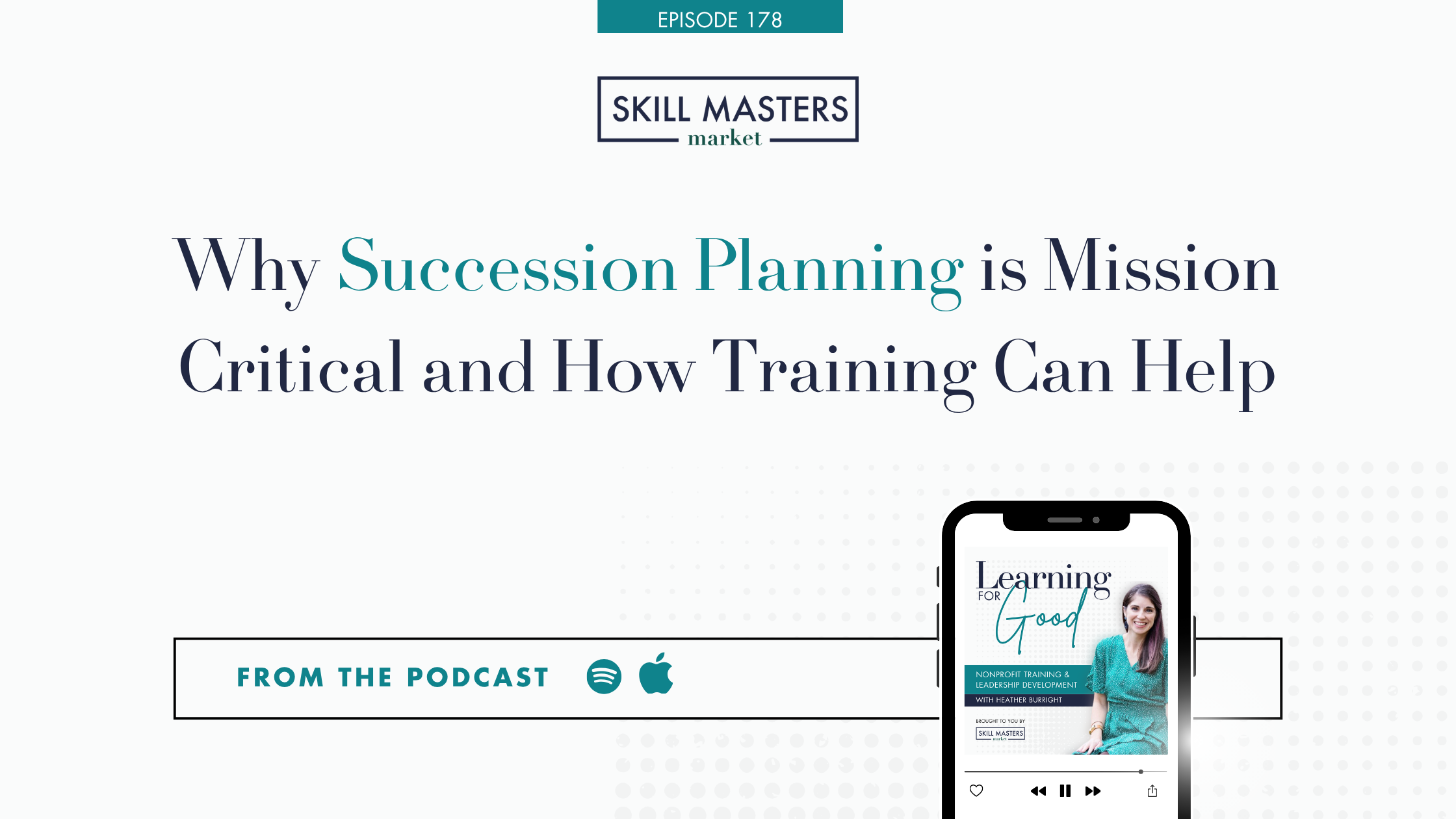
While leadership transitions are inevitable, there are too many organizations that aren’t prepared for this eventuality.
In this episode, I’ve got Jeremy Bouman with me to explore how nonprofit leadership development and intentional succession planning can protect your mission and ensure your organization continues to thrive long after a founder or executive leader steps away.
Jeremy is the founder and CEO of Rise, a Nebraska nonprofit dedicated to breaking generational cycles of incarceration. Jeremy shares how his team approaches succession planning not just as a document, but as a strategy for organizational development and long-term sustainability.
▶️ Key Points:
00:00 Breaking generational incarceration cycles
08:07 Creating a nonprofit succession plan
17:22 Keeping succession plans active and relevant
20:27 Training and preparing future nonprofit leaders
25:50 Building a learning culture within nonprofit organizations
Navigating Leadership Transition in Nonprofits
In the high-stakes world of nonprofit leadership, the mission is everything. On episode 178 of the Learning for Good podcast, I interview nonprofit leader Jeremy Bouman of Rise who is working to break cycles of poverty, incarceration, and inequity. But there is a silent threat to every nonprofit mission that many organizations ignore until it’s too late: leadership transitions.
In 2025, nonprofit CEOs left their roles at record levels. According to one search firm, over 860 CEOs exited by April alone—the highest number ever recorded for that timeframe. Yet, despite this mass exodus, the Council of Nonprofits found that only 29% of nonprofits have a documented succession plan.
If you are an HR or L&D leader, you likely feel the weight of this instability.
Creating Sustainability through Succession Planning
Jeremy Bowman, founder and CEO of Rise, understands the stakes of leadership transitions better than most. He witnessed a tragic scenario where a dynamic peer leader passed away suddenly. Because that organization had a thoughtful, documented succession plan, there was no service interruption. The mission continued, and the team had a roadmap during their time of grief.
Contrast that with many founder-led organizations that exist only as long as the founder wants to do the work. When those founders leave without a plan, the institutional knowledge walks out the door, and the organization often collapses.
As a strategic L&D partner, your role is to provide the needed stability through a robust approach to leadership development that ensures the organization isn't just surviving, but thriving through change.
Four Questions Every Succession Plan Should Answer
A documented succession plan is your roadmap for the future. It is more than just a piece of paper; it is a repository of institutional knowledge that prevents chaos. Jeremy highlights that a truly robust plan must answer the “what happens if” questions for short, medium, and long-term scenarios.
Jeremy shares these 4 critical questions for succession plans:
The Donor Question: If there is an immediate transition today, who are the 20 people most important to the mission that the organization needs to call immediately?
The Trigger Question: What specific events trigger the creation of a transition committee?
The Interim Question: Who is the interim leadership, and—crucially—do they know they are the interim?
The Training Question: What is the specific training plan to prepare internal staff for both short-term stepping in and long-term succession?
Scenario: Chaos vs. Continuity
Imagine two nonprofits: Organization A and Organization B. Both lose their long-time Executive Director to a sudden health crisis.
Organization A: They have no plan. The board scrambles. They ask HR to find a leadership course for the Associate Director. HR is already drowning in requests and can only offer a generic off-the-shelf module. Staff are confused, donors are nervous, and program delivery stalls.
Organization B: HR and L&D have already worked with the board to create a six-page roadmap. The interim leader was identified and cross-trained a year ago. The board reviews the plan annually to keep it relevant. There is grief, but there is no chaos. Program continuity remains 100%.
Organization B has proof that their programs create real change and L&D helps save the mission during a crisis.
Developing the Leadership Pipeline
A succession plan is useless if it sits on a shelf. To keep it a living, breathing document, you must build a learning culture that creates a deep bench of emerging leaders.
At Rise, Jeremy has implemented two initiatives that any strategic L&D leader can adapt:
The Rise Leadership Academy
This is a four-month program (meeting four hours once a week) designed to upskill staff at all levels. It focuses on:
Identity and Values: Personal mission statements and leadership profiles
Science-Backed Assessments: Utilizing Gallup Strengths, DISC, Lencioni’s Ideal Team Player, and the Six Types of Working Genius to help people understand their professional wiring
Soft Skills: Crucial conversations, emotional intelligence, and burnout prevention
By personally leading these cohorts, the CEO builds relationships with frontline staff, understanding their giftedness for future leadership roles.
The Rise Innovation Project
Leadership is learned by doing. Rise allows any staff member to propose a solution to an organizational problem. Here’s how they do it:
The Innovation Fair: Staff share ideas and get input from the whole team.
Piloting: The organization budgets for staff to execute a 90-day pilot.
Evaluating: Staff must show whether the project worked or not.
This fail-safe environment allows emerging leaders to practice the exact skills they will need as executives.
It’s L&D’s role to build the leadership pipeline. By upskilling staff today, you aren't just checking a box; you are fulfilling a responsibility to help people grow into their own leadership, which improves retention and builds the long-term capacity of the mission.
To learn more about this real-world experience with succession planning, tune into episode 178 of the Learning for Good podcast.
Additional Resources Just for You
Other Helpful Podcast Episodes:
Building a Learning Strategy to Support Your Succession Plan
10 Things Nonprofits Should Do When Developing Future Leaders
Subscribe to the Nonprofit L&D Insiders.
Join the Nonprofit L&D Collective.
Support the Learning for Good Podcast
Become a sponsor.
Ask a question or suggest a topic.
We love hearing from listeners!
Leave a review.
Reviews teach us what content resonates most and help us reach more people!