
How to Use Data to Inform Training Decisions
Do you have employee engagement data sitting in a survey report with no plan for turning it into action?
In this episode of Learning for Good, I sit down with Wilson Kirkpatrick, Director of People Operations at Waterford.org, to talk about how they used employee engagement data to design a coaching program that strengthened leadership trust and psychological safety.
Many nonprofit leaders collect engagement survey data every year, but once the report comes back, it often sits untouched. That data only becomes valuable when you pair it with a deliberate cycle of listening, understanding, and acting, turning a single survey into an ongoing system for organizational growth.
▶️ Key Points:
00:00 Wilson's Path Into HR and People Operations
05:21 Inside Waterford.org's Mission and Team
06:16 Turning Employee Engagement Data Into a Business Case for Coaching
11:31 Prioritizing Quick Wins When Rolling Out Coaching
15:23 Measuring the Results: Engagement Score Improvements
17:18 Advice for Leaders Who Feel Intimidated by Data
19:02 Where to Find the Data Already Inside Your Organization
Using Employee Engagement Data to Inform Training Decisions
In spring 2024, Waterford.org ran an employee engagement survey. When my guest Wilson Kirkpatrick and his team reviewed the results, two things stood out: negative sentiment related to leadership and concerns around psychological safety.
For any people operations team, those two data points together are a signal worth taking seriously. Psychological safety—the feeling that you can take risks, ask questions, and make mistakes without fear of backlash—is foundational to a high-performing team. When it's low, everything suffers: innovation, retention, learning, performance.
But Wilson didn't stop at surface-level data. His team went deeper.
“We didn’t want to look at these scores in a vacuum. We considered related and tertiary data that could help explain those scores.”
That additional context told a clearer story: coaching conversations weren’t happening consistently or effectively. Employees weren’t seeing a direct connection between the feedback they received and their own growth. And managers didn’t have a shared blueprint to guide those conversations.
From that analysis, a hypothesis emerged: if manager effectiveness could be improved through better coaching, it would address leadership sentiment and create the conditions for greater psychological safety. That was the case Wilson built for investing in a coaching program.
How he used data to make these decisions is exactly what we explored on episode 194 of the Learning for Good podcast.
How the Data Informed the Coaching Initiative for People Managers
Wilson’s team used a straightforward prioritization framework: weigh the potential depth of impact against the difficulty of implementation. High impact, lower difficulty? Do it first. High impact, harder to implement? Do it anyway but with more planning.
They rolled out a multi-layered approach across five key moves:
One-on-one talking points: Structured agenda prompts were added to every manager-employee one-on-one, covering performance, development, and growth conversations. It removed the awkwardness of bringing up difficult topics by making them a standing part of the conversation.
A coaching drip campaign via Slack: Timely, low-stakes resources pushed to managers around key moments—open enrollment, performance review season, development conversations.
Competency matrices: Both organizational and role-specific matrices were finalized and published, giving managers a concrete framework to anchor coaching conversations and set clear expectations.
A competency-based review cycle: Their first-ever review process aligned to those competency matrices, creating consistency across the organization.
AI-powered role play for manager training: A low-stakes practice environment where managers could rehearse difficult conversations before having them in real life.
Wilson didn’t just design a training or workshop for people managers. He used the data to help him create an ecosystem of support designed to make the right behaviors easier to do consistently.
Gathering Data to Prove the Value or Iterate the Learning
A year after the initial engagement survey, Waterford.org asked the same questions again.
The results told a new compelling story. Positive sentiment toward leadership rose by 19%. Psychological safety scores climbed 6%. These numbers were evidence that the people operations work had moved the needle on the things that mattered.
“We’re trying to create an ecosystem. There’s no finish line.”
Wilson wasn’t looking for a single success story to point to. He was building a system that keeps listening, adjusting, and improving. This is what it looks like when HR and L&D lead strategically. Wilson’s team wasn’t just delivering programs; they were designing for change and measuring whether the change happened.
Where to Find Data in Your Nonprofit
Wilson started with data from a tool many organizations have: the employee engagement survey. And, he made the most of it by asking better questions about what the data meant.
Wilson also pointed to HRIS data as an underutilized goldmine: tenure, compensation history, time since last promotion, manager changes, recognition. When you look at those data points together, they can tell you a lot about who might be at risk of disengaging or existing your organization.
Wilson’s advice for anyone getting started with data:
Always ask: what is this data actually telling me? Not just the scores, but the story.
Challenge your assumptions and watch for confirmation bias. The data should challenge you, not just confirm what you already believed.
Bring in other perspectives. Share raw data with someone who hasn’t been steeped in it and compare what you each see.
Getting Started with Data for Learning
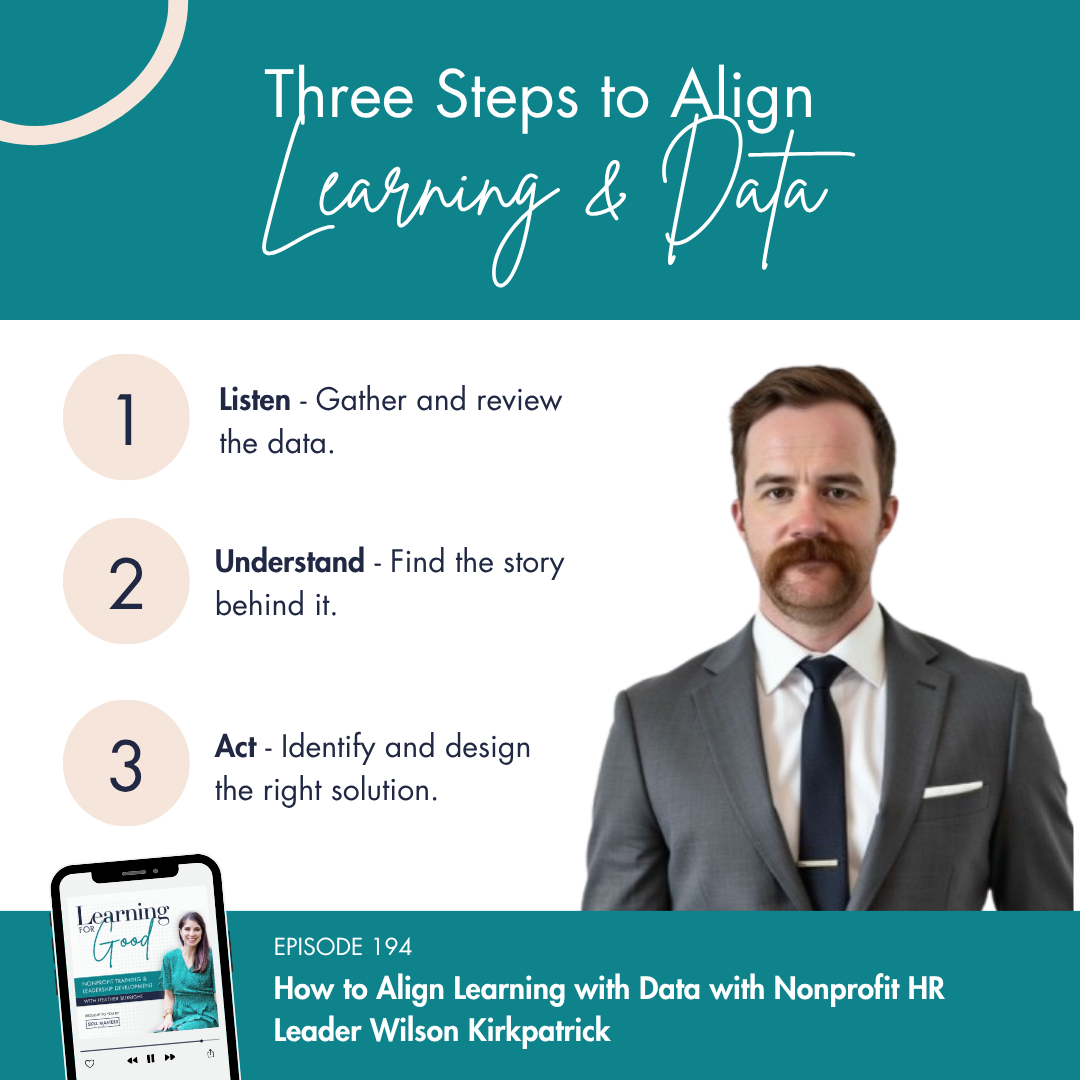
Wilson shares these three steps for using data: Listen, Understand, and Act.
Listen: Gather and review the data.
Understand: Find the story behind it.
Act: Identify and design the right solution.
So if you’re just getting started, keep it simple. Identify one question you care about, find one data source that might help you answer the question and find the story, design a solution to solve for it, and then bring the discipline to ask the same question again to see your results.
To learn more about aligning learning and data in your nonprofit, tune into episode 194 of the Learning for Good podcast.
Additional Resources Just for You
Other Helpful Podcast Episodes:
Subscribe to the Nonprofit L&D Insiders.
Join the Nonprofit L&D Collective.
Support the Learning for Good Podcast
Become a sponsor.
Ask a question or suggest a topic.
We love hearing from listeners!
Leave a review.
Reviews teach us what content resonates most and help us reach more people!