From Content Creation to Curation: How AI Can Revolutionize Learning and Development
AI is rapidly reshaping nonprofit leadership development, and organizations that embrace it now will be better positioned to build stronger teams, scale impact, and drive consistent performance.
In this episode, I sit down with the president and CEO of the YMCA of Greater Cincinnati, Jorge Perez, to explore how AI is transforming learning and development strategies and what that means for nonprofit leaders today. Jorge shares how his organization is already using AI to enhance staff training and development, streamline workflows, and support leadership growth in real time.
▶️ Key Points:
00:00 Jorge’s nonprofit leadership journey insights
07:48 AI is changing how nonprofits operate
18:52 AI opportunities for learning leaders
21:26 AI concerns: ethics, security, and quality
25:48 Start experimenting with AI today
The Impacts of AI
The world is shifting. Just as the telephone revolutionized communication 150 years ago, Artificial Intelligence is revolutionizing the way we work today. If we aren’t thinking about how to use it, we will fall behind. It is time to shift our identity from a support function to a leadership function and leaders need to be at the forefront of AI.
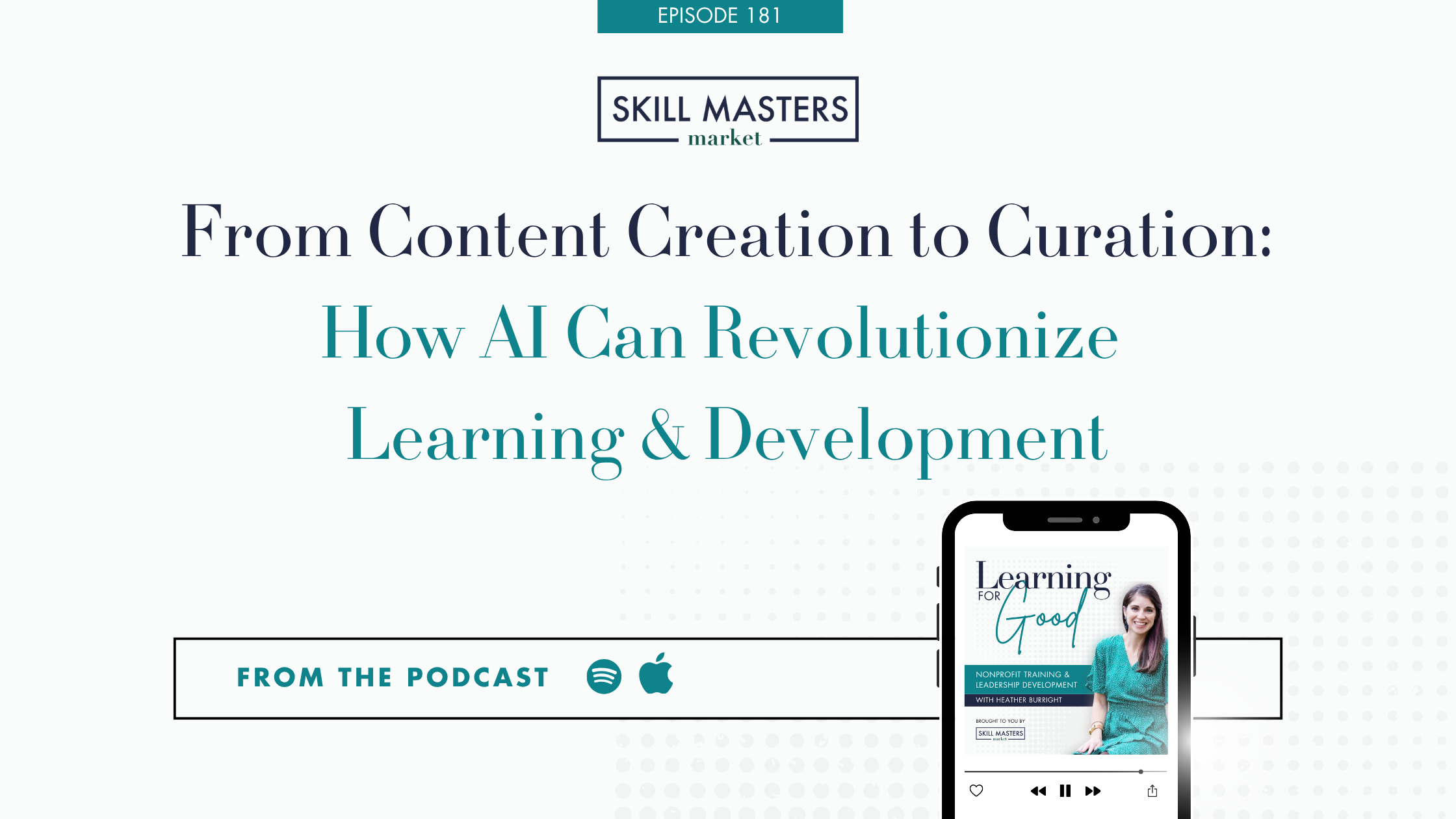
On episode 181 of the Learning for Good podcast, I sat down with Jorge Perez, President and CEO of the YMCA of Greater Cincinnati, to discuss how AI is changing the nonprofit landscape. Jorge is a visionary leader who has embraced AI not just as a tool, but as a strategic partner in organizational growth. Our conversation revealed that for L&D leaders, AI is the key to moving from an overwhelmed order-taker to a strategic partner with the time and confidence to focus on higher-value work.
How Training Professionals Can Use AI
One of the biggest hurdles in nonprofit L&D is strained capacity. We have too many requests and not enough headcount. Jorge suggests a powerful reframing: think of AI as “the smartest intern you can ever hire,” and one who is available 24/7.
Unlike traditional tools that are under our 100% control, AI is a tool that talks back. It can take the first draft of a project, advise you on strategy, and even do work while you are sleeping. This isn’t just about having a smarter version of Alexa; it is a fundamental shift in how we expand our team’s capacity without adding headcount.
Imagine a world where you aren't spending all of your time drafting basic training outlines or summarizing meeting notes.
Instead, you are using AI to:
Interpret complex data: Jorge uploaded a personality profile and his organization’s strategic plan to an AI, asking it to help him interpret how the two intersect.
Automate repetitive tasks: Creating monthly newsletters, which often feel like a chore nobody wants, can now be handled by a system that edits, formats, and even translates content into multiple formats automatically.
Provide just-in-time support: Jorge’s team uses custom AI agents like “Frankie” (a finance expert) to provide board members and staff with immediate answers to complex questions.
By treating AI as an intern, you gain your time back to focus on more strategic things.
The Mindset Shift around AI
To truly show up as a change agent, Jorge suggests we must embrace a second major shift: moving from creators to curators.
For decades, L&D has been in the seat of creation. We believed our value was in building everything from scratch—the slide decks, the workbooks, the eLearning modules. But in an AI-driven world, creation is becoming cheap and instantaneous. The real value now lies in curation.
A curator at a museum doesn't paint the pictures; they decide which pictures to display, how they work together, and what experience they give to the visitors.
Jorge suggests the new role of L&D is to:
Guide and Refine: You use AI to generate content, but you use your strategic expertise to refine it, ensuring it aligns with your organization's unique values and goals.
Pressure Test: You must curate the knowledge you share by testing AI agents to make sure they do what they need to do.
Personalize the Experience: AI allows you to offer learning in multiple formats at no extra expense. Do your learners want a PDF, a podcast, or a song in Spanish? Curation is about selecting the right channel for the right impact.
Scenario: The "Nightmare" Newsletter Made Simple
To see this shift in action, consider the old way of managing a monthly staff newsletter. Usually, this is a manual task that involves chasing people for stories, fixing misspelled words, struggling with formatting, and eventually producing a PDF that only half the staff reads.
The Reactive Response: You spend hours every month acting as a content creator.
The Strategic Response: Jorge’s team built an AI system for their newsletter. Staff submit stories to an online platform where an AI editor automatically fixes spelling and consistency issues. The AI then handles all the formatting. Finally, the AI provides options for how the news is consumed—whether as a hard copy, a digital version, or an audio file for staff to listen to on their drive home.
A human remains in the loop to review and make final adjustments, but AI did 90% of the heavy lifting. The result? A professional product delivered in minutes, freeing staff to focus on driving organizational strategy.
Navigating AI Ethics and Security
It is natural to have hesitations about AI, particularly regarding security, ethics, and quality. However, Jorge warns against what he calls the “roll bar” trap, which is where you are so concerned about safety that you never actually start driving.
“Don't overcomplicate the simple things,” Jorge advises. You don't need a NASCAR racecar with extra roll bars just to go pick up bread.
To navigate these concerns strategically:
Train your AI like an employee: Just as you wouldn't tell a new employee to work without training them on your values and code of ethics, you must train your AI agents to follow your principles.
Set clear boundaries: Jorge shares financials with his AI agents because he has trained them not to use that data to train the broader system. However, he still avoids putting highly sensitive data like Social Security numbers on these platforms.
Keep the human in the loop: Curation requires a human to verify the output. Your strategic expertise is what ensures the AI's draft meets the organization's high standards.
How to Get Started with AI
Confidence in AI comes from practice. You don't need to be a coder to use these tools; you just need to know how to talk to them.
Nonprofit L&D pros show up as change agents when they stop being afraid and start experimenting.
Jorge recommends three simple ways to get started this weekend:
Watch One Video a Week: Spend 10-15 minutes on YouTube picking a platform you are curious about (Co-pilot, ChatGPT, Claude). Within two months, you will likely be the smartest person on AI in your network.
Create One Simple Agent: Build an AI agent for something you are already an expert in, even if it isn't work-related—like Italian cooking. Learning how to train an agent for your favorite recipes will teach you the mechanics of how to build one for your nonprofit's finance committee or leadership academy.
Find Your Community: Get around people who are early adopters. If you only listen to those who talk about how dangerous AI is, you will never take the steps needed to revolutionize your work. Surround yourself with a network—like the Nonprofit L&D Collective—that can help you troubleshoot and encourage your growth.
Final Thoughts on AI
You may disagree about the shift from content creation to curation. You may have a different idea about how your organization will use AI. And that’s ok. But AI is a major shift that is going to shape our world more than the smartphone or the internet. As a nonprofit leader, you have a choice: you can remain overwhelmed by the intake chaos, or you can embrace the technology that allows you to drive your mission further than ever before.
To learn more about how this nonprofit is using AI, tune into episode 181 of the Learning for Good podcast.
Additional Resources Just for You
Other Helpful Podcast Episodes:
Subscribe to the Nonprofit L&D Insiders.
Join the Nonprofit L&D Collective.
Support the Learning for Good Podcast
Become a sponsor.
Ask a question or suggest a topic.
We love hearing from listeners!
Leave a review.
Reviews teach us what content resonates most and help us reach more people!