Why does your team go right back to their old habits the week after training ends?
In this episode of Learning for Good, I break down how nonprofit leaders can design training that leads to lasting workplace behavior change instead of a short-lived bump in knowledge. Most training ends the same way. People show up, they learn something new, and within a few weeks it is like the training never happened. If this sounds familiar, you are not alone, and it is not because your training was bad.
What matters is designing for what happens after training ends, so the learning people carry with them actually changes what they do on the job.
▶️ Key Points:
00:00 How to Make Learning Last
05:03 The Real Goal of Nonprofit Staff Training and Development
05:36 The Four Gears of Lasting Behavior Change
Why Training Doesn’t Last
Why doesn’t training last? The short answer: it isn’t meant to.
If you've ever wrapped up a training and thought, “That went great,” only to watch old habits creep back in two weeks later, you're not imagining things. And you're definitely not alone.
Most nonprofit training is built to be memorable. Very little of it is built to be lasting.
Think about the things you buy that are meant to last—a car, a home, a piece of furniture you chose carefully because you wanted it to hold up. Now think about the things that aren’t: trash bags, laundry detergent, the food in your fridge. You use them, they do their job, and they’re gone.
Training belongs in the second category. It’s consumable. It happens, it serves its purpose in the moment, and then it’s over. But the learning—the actual shift in how someone thinks and acts—that’s what’s supposed to last.
So if training itself isn’t the goal, what is? Change is. And that means the real measure of a successful program isn’t whether people showed up or whether they liked it. It’s whether they’re still using what they learned a month from now. A year from now.
So why aren’t we creating the change we need?
Most training design puts nearly all its energy into what happens during the session: the content, the activities, the facilitation. Almost none of it goes toward what happens after people walk out the door and back into their actual jobs.
That’s a problem because behavior doesn’t happen in a training room. It happens on autopilot, in the middle of a busy workday, shaped by whatever cues are already sitting in someone’s environment.
You know this feeling already: you drive home from work and realize you don’t remember the drive. You weren’t unconscious; your brain was just running on the cues it already knew. Work operates the same way. Your staff aren’t thinking, “What did I learn in that training last Tuesday?” They’re reacting to whatever is prompting them in the moment. And if the old cues are still there, the old behavior wins.
If we want learning to survive contact with a real, busy, distraction-filled workday, we have to design for what happens after the training with just as much intention as what happens during it.
So that’s what I’m exploring on episode 196 of the Learning for Good podcast.
The Four Conditions of Lasting Behavior Change
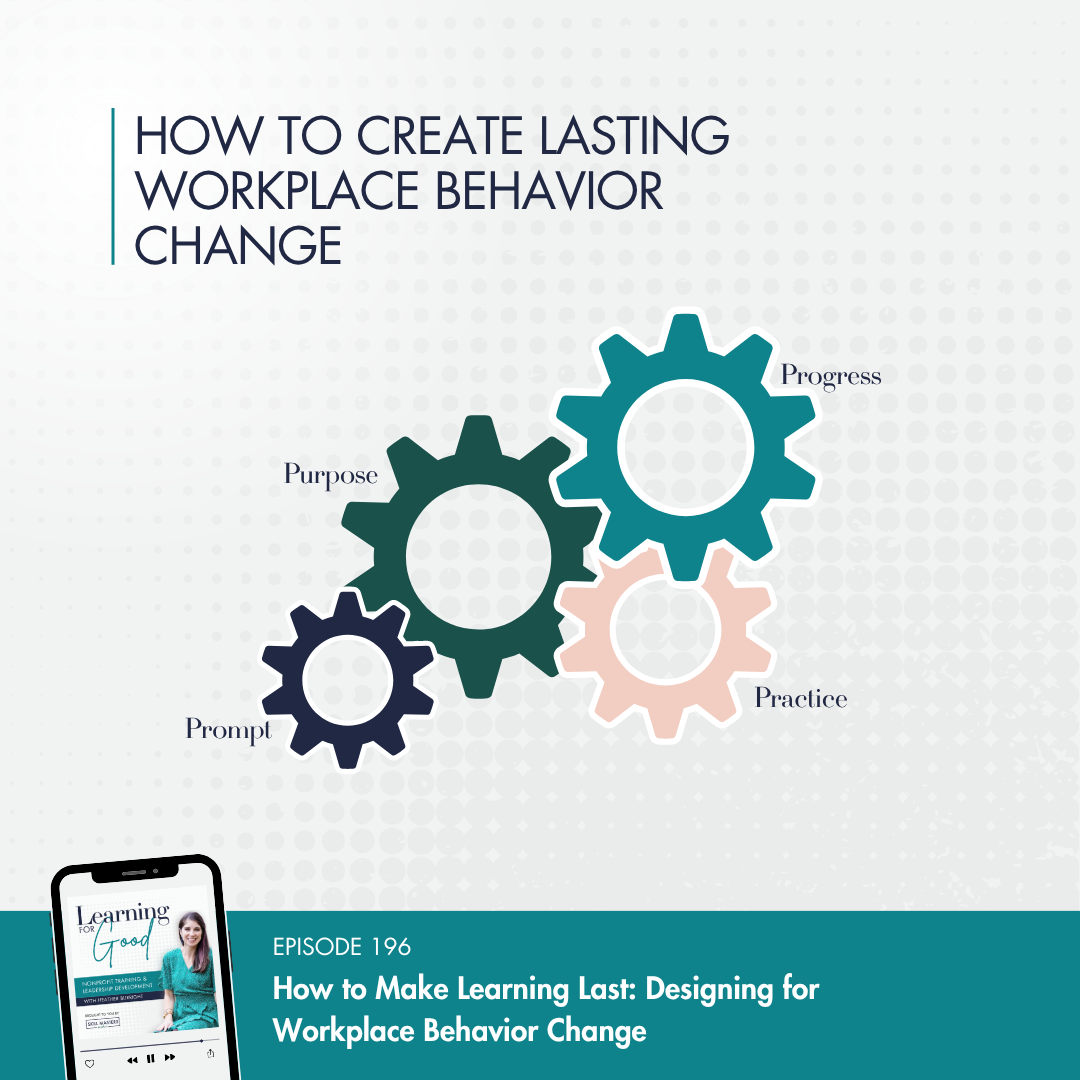
Picture a bicycle. Each gear turns the next. When they’re aligned, the whole system moves forward. Remove even one gear, and everything stops.
Behavior change works the same way. There are four gears, and all four have to be in place.
Gear 1: See It
This is the prompt.
People need to recognize the moment to use their new skill. Without a clear cue, even well-trained staff default back to old habits.
Ask yourself: what will actually prompt someone to use this back on the job? Is it a step built into an existing process? A habit stacked onto something they already do? A quick job aid they can glance at in the moment they need it? The goal isn’t just “do they know how,” it's “will they recognize when.”
Gear 2: Want It
What’s the purpose?
Knowing how to do something and wanting to do it are two very different things. Motivation has to be built in intentionally, not assumed.
People change behavior when they understand why it matters—not in a generic, “because leadership said so” way, but in a way that’s personally relevant. Will this new behavior make their job easier? Help them serve more people? Support the mission they signed up for in the first place? Connect it to something they already care about, and the behavior becomes something they choose, not something they comply with.
Gear 3: Practice It
Practice continues long after the training ends.
Nobody becomes skilled from a single session, no matter how well it’s designed. Think about learning to drive: driver’s ed wasn’t what made you a confident driver. It was the daily practice afterward—the rush-hour traffic, the rainy nights, the unfamiliar roads—that built real capability.
Training can only take people so far. The confidence and competence that actually stick are built through repeated practice on the job, with support. That means thinking beyond the session and asking: who’s coaching them afterward? What does peer support look like? How will they know if they're doing it well, or where they need to adjust? If the answer is “no one, and they're on their own,” this gear is missing—and the whole system stalls.
Gear 4: Feel It
People need to feel their own progress, not just achieve a final result.
Think about the satisfaction of closing a ring on a fitness tracker. The notification itself doesn’t make you healthier, but it reminds you that you’re making progress and to keep going.
Growth is uncomfortable. New behaviors feel clunky before they feel natural, and without some kind of acknowledgment along the way, people tend to give up and slide back to what’s familiar. Recognition— from a supervisor, a peer, or even a simple, built-in way to track progress—helps people keep going when it’s challenging.
Together, these gears create change.
To learn more about creating lasting workplace behavior change, tune into episode 196 of the Learning for Good podcast.
Additional Resources Just for You
Other Helpful Podcast Episodes:
Subscribe to the Nonprofit L&D Insiders.
Join the Nonprofit L&D Collective.
Support the Learning for Good Podcast
Become a sponsor.
Ask a question or suggest a topic.
We love hearing from listeners!
Leave a review.
Reviews teach us what content resonates most and help us reach more people!