5 Lessons that Will Change How You Show Up in Nonprofit L&D
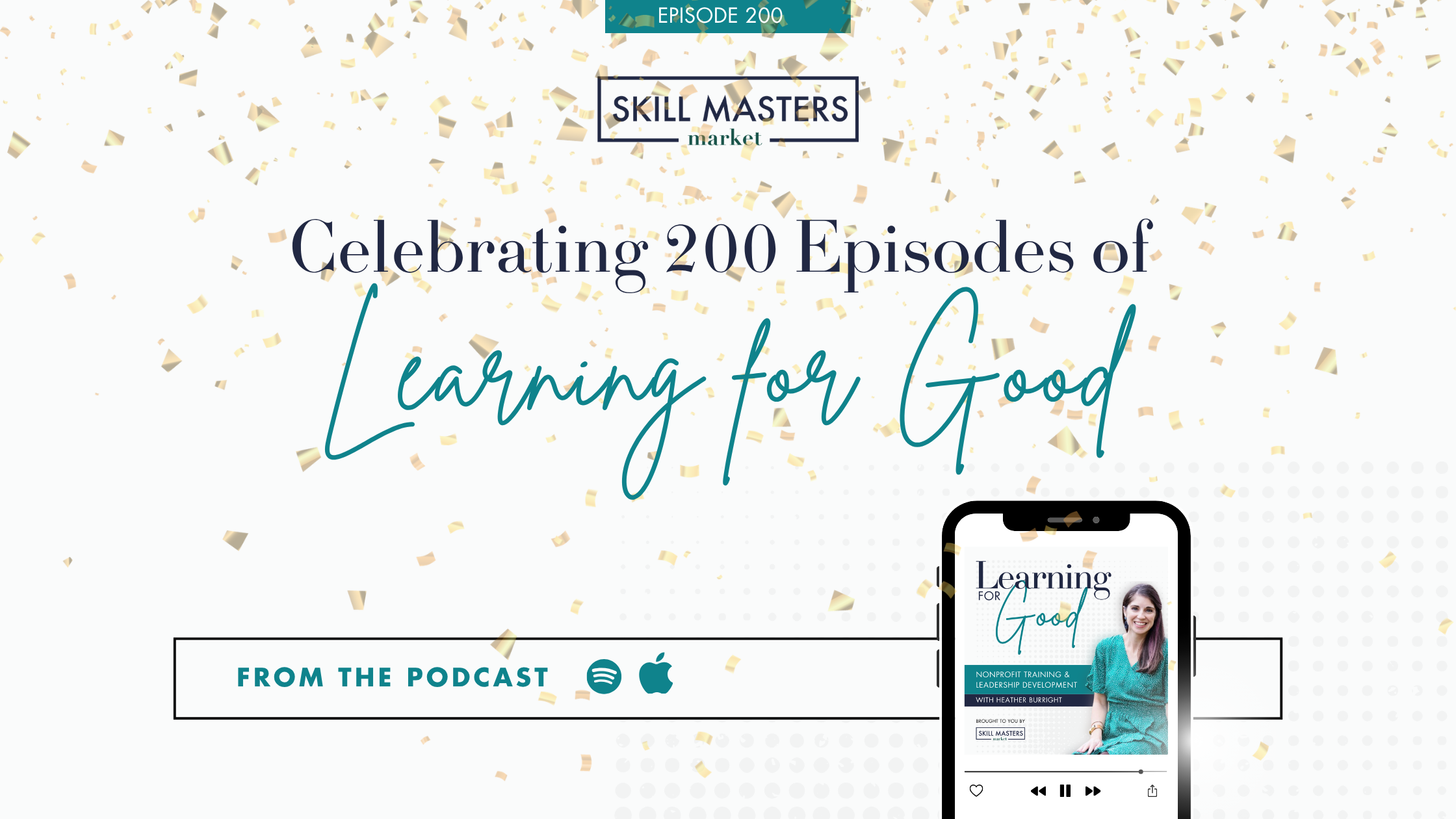
In this episode of Learning for Good, I celebrate 200 episodes and share the five biggest lessons that have shaped my approach to nonprofit learning and development and nonprofit leadership development.
Two hundred episodes in, I have interviewed nearly a hundred guests, built a summit, and grown a community, and along the way, my thinking about staff training and development has shifted in ways I did not expect. This episode is a chance to pause and look back at what has actually changed my career.
▶️ Key Points:
00:00 200 Episodes of Learning for Good
02:33 Thank You to the Nonprofit L&D Community
03:44 Top Five Episodes: A Look Back at Nonprofit Learning and Development Highlights
05:09 5 Ideas that Changed My Career in Learning and Development
200 Episodes of the Learning for Good Podcast
This month marks 200 episodes of Learning for Good, and in that time I’ve talked with nearly 100 guests: bestselling authors, nonprofit executives, and L&D practitioners doing the real work inside mission-driven organizations.
Somewhere across those conversations, my own thinking sharpened. Five ideas in particular changed how I operate, how I advise clients, and how I’d encourage you to think about your own role. None of them are complicated. But they are definitely worth sharing!
Here’s what 200 episodes taught me — and what they can teach you.
What is the Goal of Training?
Lesson 1: Training isn’t the goal; change is.
Most of us entered this field because we like training — building a good workshop, writing a clean facilitator guide, watching a room engage. That instinct is natural, but it shifts our attention toward the wrong metric. Training is an output. Behavior change is the outcome. And if you’re only focused on whether the training happened — whether it got built, whether it got delivered, whether people showed up — you’re focused on activity, not impact.
If you think about that distinction…
When training is the goal, success is “we shipped it.”
When change is the goal, success is “people are doing something differently, and the organization is better for it.”
The latter is what we’re going for.
How Can We Get Buy-In in Learning and Development?
Lesson 2: None of this works without relationships.
You can have the sharpest instructional design skills in the sector and still fail if you haven’t built trust with the people around you. Across dozens of guest conversations, this pattern kept resurfacing in different forms. One guest built a coaching program for their nonprofit. But, they started by listening to needs, not by proposing curriculum or coaching model. Another guest made data-driven decisions, but they didn’t just review spreadsheets; they sat down with the people in their nonprofit. A guest who redesigned career pathways found that people didn’t buy in because the plan was smart; they bought in because they helped shape it. So this guest involved staff in the process. Another described leading a cohort-based training model where the real driver of engagement wasn’t the content; it was learners knowing their peers were doing the work alongside them.
The common thread: relationships aren’t a soft skill you layer on top of L&D work. They are the work. They’re what earn you a seat before anyone thinks to invite you to one, and they’re what turns a training request into a genuine strategic conversation about what the organization actually needs.
How Do We Create Workplace Behavior Change?
Lesson 3: Design more than training.
See if this scenario sounds familiar: a program director asks for a workshop on giving better feedback. You deliver a strong session — clear frameworks, practice scenarios, confident participants walking out the door. Three weeks later, nothing has changed. Why? Because the performance review still measures something else. Because their own supervisor never models the behavior you just taught. Because there’s friction in the process that makes the new approach harder than the old one.
Skills are necessary, but they’re only one ingredient. Change also requires motivation, opportunity, and support in the environment where the behavior needs to happen. You can hand someone a brand new skill, and they will still fall back on old habits on Monday morning if nothing around them reinforces it. This is the difference between designing a training and designing for change. We have to look past the workshop and into the systems, incentives, and manager behaviors surrounding it.
How Do We Prove Training Value and ROI?
Lesson 4: Proof is the price of admission.
Trust in institutions, and increasingly in each other, is at a low point. “Just trust me; this training works” is no longer a strategy anyone can afford to lean on. As L&D leaders, we need proof, and we need to be able to tell the story of the value we provide.
That means two things. First, measurement can’t be an afterthought bolted on at the end of a project. It has to be built in from the start, across every level: satisfaction, knowledge, behavior, and impact. Second, completion rates alone don’t count as proof. A 100% completion rate tells you people showed up. It tells you nothing about what they’re doing differently because of it. Real proof answers the second question, not just the first. Measurement isn’t the finish line of a project; it’s how you know you solved the right problem, actually changed behavior, and earned the trust to be asked back.
Build measurement in early. Before a program launches, decide what you’ll look at 30, 60, and 90 days out, and who needs to see it. A one-page follow-up showing a shift in behavior — even a modest one — will do more for your credibility than a 100% completion rate.
Will AI Replace Learning and Development?
Lesson 5: The future belongs to strategic learning leaders.
Information has never been more accessible. Off-the-shelf content libraries are built into most LMS platforms now, and AI is already reshaping what “training content” means. If your value is producing content, that value is shrinking fast. So the real question is: what do you bring that a course library or an AI tool can’t?
The answer is your judgment. Your relationships. Your ability to ask the right strategic questions, diagnose whether training is even the right lever, and apply behavior-change principles to a specific, messy, human organization.
AI can generate a module. It cannot sit in a stakeholder meeting and read the tension in the room, and it cannot build the trust that makes people willing to change.
To learn more about each these valuable lessons, tune into episode 200 of the Learning for Good podcast.
Additional Resources Just for You
Other Helpful Podcast Episodes:
Want to Work in Nonprofit Learning and Development? What You Should Know
Translating Behavior Science into L&D Strategy: Lessons from Top Experts
Using a Blended, Cohort Training Model to Create Behavior Change
How to Conduct a Training Needs Analysis for Nonprofit Staff Development
Subscribe to the Nonprofit L&D Insiders.
Join the Nonprofit L&D Collective.
Support the Learning for Good Podcast
Become a sponsor.
Ask a question or suggest a topic.
We love hearing from listeners!
Leave a review.
Reviews teach us what content resonates most and help us reach more people!